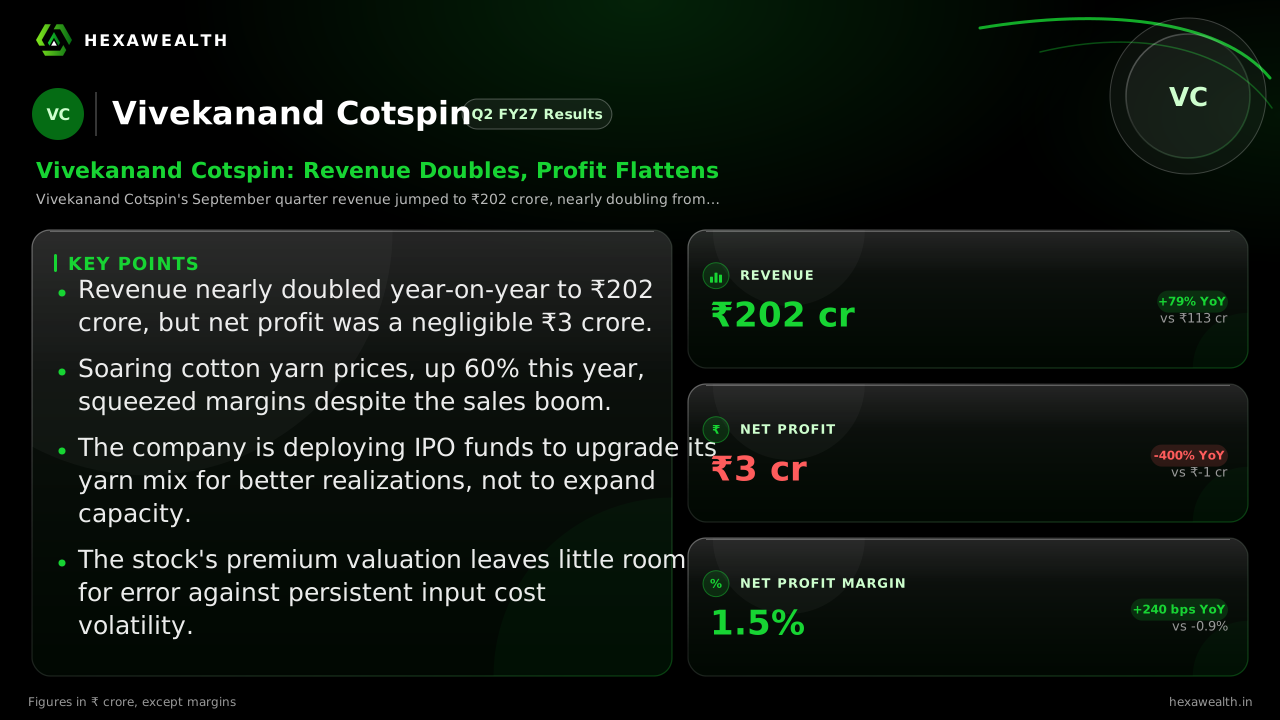
Vivekanand Cotspin (VIVEKANAND) Q2 FY27's Revenue Doubles, But Profit Barely Budges
The cotton spinner's Q2 FY27 sales surged 79% year-on-year, but a severe margin squeeze kept net profit at a wafer-thin ₹3 crore.
Vivekanand Cotspin's September quarter revenue jumped to ₹202 crore, nearly doubling from last year. However, net profit remained negligible at ₹3 crore, highlighting the intense cost pressures in the commodity spinning business.
For a commodity spinner like Vivekanand Cotspin, a quarter of booming sales is only half the story. The real test is whether those top-line gains can survive the relentless squeeze of raw material costs. The September quarter delivered a dramatic sales jump, but profit tells a different tale.
Revenue soared 79% year-on-year to ₹202 crore. Yet, net profit was a mere ₹3 crore, translating to a net margin of just 1.5%. While this marks a technical return from last year's loss, it shows how little of the sales surge reached the bottom line.
Revenue & profit
Revenue (₹ Cr)
Net Profit (₹ Cr)
- Revenue (₹ Cr), Q2 FY26: 113.0
- Revenue (₹ Cr), Q2 FY27: 202.0
- Net Profit (₹ Cr), Q2 FY26: -1.0
- Net Profit (₹ Cr), Q2 FY27: 3.0
Revenue (₹ Cr)
- Revenue (₹ Cr), Q2 FY26: 113.0
- Revenue (₹ Cr), Q2 FY27: 202.0
Net Profit (₹ Cr)
- Net Profit (₹ Cr), Q2 FY26: -1.0
- Net Profit (₹ Cr), Q2 FY27: 3.0
Net Profit Margin
- Net Profit Margin, Q2 FY26: -0.9%
- Net Profit Margin, Q2 FY27: 1.5%
| Metric | CurrentQ2 FY27 | Same quarter LYQ2 FY26 |
|---|---|---|
| Revenue (₹ Cr) | 202.0YoY +79% | 113.0 |
| Net Profit (₹ Cr) | 3.0YoY +400% | -1.0 |
| Net Profit Margin | 1.5%YoY +267% | -0.9% |
Why the profit didn't follow sales
The gap between soaring revenue and flat profit points directly to costs. Total expenses rose 72%, nearly keeping pace with sales. The primary culprit is the volatile price of cotton, the company's key raw material.
Research from StockGro notes cotton yarn prices surged nearly 60% by September 2026. For a business with net margins historically below 1%, such input cost inflation is devastating. It erodes the value of every rupee of sales before it can become earnings.
A strategy shift within existing walls
With its core spinning unit running at just 67% capacity last fiscal, the company isn't chasing volume. Instead, it's using IPO funds to upgrade machinery, aiming to produce higher-value combed and compact yarn.
Live Chart
· VIVEKANAND
(BSE)
ISIN: INE1JJP01018
A report by Multibagg.ai details a ₹5.27 crore capex plan to improve the product mix, not add capacity. The goal is to earn an extra ₹5-10 per kilogram on some output. This is a necessary move in a commodity market, but its success hinges on demand for these premium grades.
The valuation of a slim chance
Investors are being asked to pay a premium for a business with razor-thin defenses. The stock trades at a P/E of 50.5, above the industry average of 46.5. This pricing assumes the product-mix upgrade will work and that cotton costs will stabilize.
Institutional interest has emerged post-IPO, with FIIs and DIIs together holding about 13% by September 2026, according to Indmoney data. This suggests some faith in the long-term plan, but the near-term remains hostage to cotton markets.
Key Points
- Revenue nearly doubled year-on-year to ₹202 crore, but net profit was a negligible ₹3 crore.
- Soaring cotton yarn prices, up 60% this year, squeezed margins despite the sales boom.
- The company is deploying IPO funds to upgrade its yarn mix for better realizations, not to expand capacity.
- The stock's premium valuation leaves little room for error against persistent input cost volatility.
Hexa Perspective
This quarter underscores the fundamental tension in commodity processing: top-line growth is volatile and often cost-led, not profit-led. The return to a slim profit is a step, but sustainability is the real question.
The upgrade to a premium yarn mix is a logical strategic response to low capacity utilization and thin margins. However, its financial impact will be gradual and remains untested. The investment case rests on management's ability to navigate cotton price swings while successfully executing this shift, a challenging balance in a fiercely competitive market.
Also read
Want this applied to your portfolio?
Talk to a HexaWealth advisor, or sync your mutual fund data for insights tailored to your holdings.