All posts

Follow Us

LinkedInInstagramX
Quarterly ResultsArchiveLast updated 4 November 20263 min read

Vivaa Tradecom (VIVAA) Q2 FY27 Profit Stalls Despite a 58% Revenue Surge

The textile trader's September quarter sales jumped 58% year-on-year, but net profit remained flat as costs kept pace, highlighting its thin-margin business model.

By Anant Kacholia, HexaWealth Research · Created 4 November 2026

Vivaa Tradecom's Q2 FY27 revenue surged 58% to ₹202 crore, yet net profit stayed at ₹1 crore. The flat bottom line reflects a margin squeeze in a trading business where costs move in lockstep with sales.

For a textile trader like Vivaa Tradecom, growth is measured in volume and velocity, not margin. The September quarter saw that volume arrive, with revenue surging 58% year-on-year. Yet the bottom line tells a different story, as profit stayed flat, revealing the tightrope of its low-margin business.

The numbers show a clear split. Revenue hit ₹202 crore, up sharply from ₹128 crore a year ago and ₹157 crore last quarter. Net profit, however, was unchanged at ₹1 crore year-on-year, though it recovered from near-zero in the March quarter. The net profit margin contracted 30 basis points from last year to 0.5%.

Revenue & profit

Revenue (₹ Cr)

Profit (₹ Cr)

Net Profit Margin

MetricCurrentQ2 FY27Same quarter LYQ2 FY26
Revenue (₹ Cr)
202.0YoY +58%
128.0
Profit (₹ Cr)
1.0YoY 0%
1.0
Net Profit Margin
0.5%YoY -38%
0.8%

The squeeze behind the sales jump

The revenue surge was not matched by profit because total expenses grew almost in lockstep, rising 58.3% year-on-year. As a pure trading intermediary, Vivaa buys finished fabrics and resells them, keeping only the thin difference between purchase and sale prices. A report from Newboard notes freight costs alone take most of that gap, leaving a wafer-thin trading spread.

This quarter, that spread was compressed. While ScanX.trade reported some expense control, the fundamental model offers little pricing power. The company is a middleman in a crowded market, with prices set by supply and demand.

A volatile backdrop for textiles

The broader industry context adds pressure. According to an ET Edge Insights report, India's textile exports are recovering but face sharply rising input costs. Cotton yarn prices rose about 60% by September 2026. For a trader like Vivaa, such volatility in raw material costs can squeeze margins further if they cannot pass them on immediately.

Working capital showed a mixed picture. ScanX.trade reported trade receivables decreased, helping generate positive operating cash flow of ₹18.9 lakh. However, inventory rose slightly, and the company reduced trade payables, which may strengthen supplier ties but ties up cash.

Key Points

  • Revenue growth of 58% year-on-year was driven by higher trading volumes but did not translate into profit growth.
  • The net profit margin of 0.5% reflects the inherent thin margins of a textile trading business with limited pricing power.
  • Positive operating cash flow this quarter was aided by lower receivables, but the business remains sensitive to textile input cost volatility.
  • The company trades at a significant premium to the industry, with a P/E of 83.3 against a sector average of 45.0.

Hexa Perspective

Vivaa Tradecom's quarter underscores a model where top-line growth is not synonymous with profitability. The business is structurally designed for high turnover on razor-thin spreads, making it highly sensitive to even minor cost increases or pricing pressures in the textile chain.

The valuation premium appears to price in growth momentum, but not the margin reality. For the stock to sustain its run, investors must believe the company can consistently win volume without sacrificing its already slim spreads—a challenging proposition in a cyclical, competitive trade.

Share or follow HexaWealth

Also read

Want this applied to your portfolio?

Talk to a HexaWealth advisor, or sync your mutual fund data for insights tailored to your holdings.
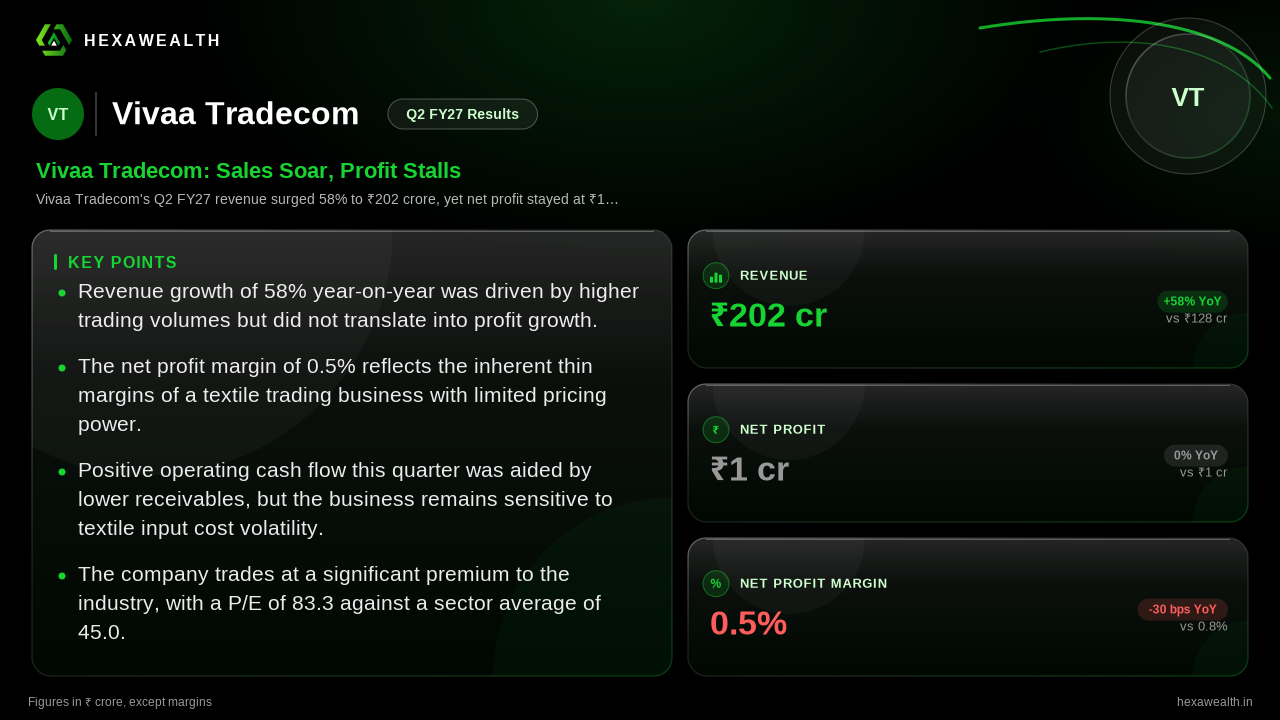
Vivaa Tradecom (VIVAA) Q2 FY27 results, revenue and profits.

Frequently asked questions

What were Vivaa Tradecom's Q2 FY27 results?
Vivaa Tradecom reported Q2 FY27 revenue of ₹202 crore, a 58% increase year-on-year. Net profit was ₹1 crore, flat compared to the same quarter last year. The net profit margin contracted to 0.5% from 0.8% in Q2 FY26.
Why did Vivaa Tradecom's Q2 FY27 revenue surge 57.8% YoY while profit remained flat?
Vivaa Tradecom's revenue jumped due to higher trading volumes. Profit stayed flat because total expenses grew almost in lockstep, rising 58.3% year-on-year. The company's thin-margin trading model offers little buffer, as costs move directly with sales.
What caused Vivaa Tradecom's net profit margin to contract in Q2 FY27?
Vivaa Tradecom's net profit margin fell 30 basis points year-on-year to 0.5% because expense growth nearly matched revenue growth. As a trading intermediary, its margin is the slim difference between buy and sell prices, which was compressed this quarter.
Was Vivaa Tradecom's Q2 FY27 profit driven by one-off items?
No, Vivaa Tradecom's Q2 FY27 profit of ₹1 crore appears driven by core trading operations. ScanX.trade reported the jump was due to robust top-line growth and controlled expenses, with no mention of exceptional items in the quarter.
What is the demand environment for traded textiles like denim and polyester?
The textile export environment is recovering but volatile. An ET Edge Insights report notes Indian textile exports grew 10.3% in April-August 2026, but cotton yarn prices surged about 60% by September, creating a cost squeeze for the entire value chain.
What is Vivaa Tradecom's working capital situation after the revenue jump?
Vivaa Tradecom's working capital showed mixed signals. ScanX.trade reported trade receivables decreased, helping generate positive operating cash flow. However, inventories rose slightly, and the company reduced trade payables, which may impact immediate cash availability.
Did Vivaa Tradecom management provide guidance for FY27?
Management has not provided explicit forward guidance, according to a StockFin.ai analysis. The recent focus has been on administrative streamlining, like relocating its registered office, rather than issuing new strategic or financial targets.
Did Vivaa Tradecom's Q2 FY27 results beat analyst estimates?
Vivaa Tradecom does not have active analyst coverage or published consensus estimates for revenue and profit, as noted by Sharpely.in. Therefore, its results cannot be judged against typical analyst expectations.
Are mutual funds or FIIs increasing their stake in Vivaa Tradecom?
No. As of September 2026, shareholding data from AnandRathi shows FII, DII, and mutual fund holdings in Vivaa Tradecom were all at 0.00%. The company's ownership is concentrated among promoters (30.11%) and public shareholders.
How did Vivaa Tradecom's stock price react to the Q2 results?
Specific price action on the November results date is not detailed in the research. However, StockFin.ai notes the stock had delivered a 160.62% return over the past year, indicating strong prior sentiment ahead of this earnings report.
What are the key risks for Vivaa Tradecom's business?
Key risks include extreme customer concentration, with the largest buyer accounting for 89.26% of FY23 revenue. The company also has no pricing power as a middleman, operates on very thin margins, and has no long-term contracts with customers or suppliers.
Vivaa Tradecom Q2 profit drop
Vivaa Tradecom's Q2 FY27 net profit did not drop year-on-year; it was flat at ₹1 crore. However, it failed to grow despite a 58% revenue surge, highlighting a significant margin squeeze in its trading operations during the quarter.
Vivaa Tradecom Q2 net profit
Vivaa Tradecom's Q2 FY27 net profit was ₹1 crore, unchanged from the ₹1 crore profit in Q2 FY26. This result came alongside a major revenue increase to ₹202 crore from ₹128 crore a year earlier.