Unishire Urban Infra (UNISHIRE) Q4 FY26's Revenue Falls 30% as Losses Deepen in FY26
The Bangalore real estate developer saw a sharp annual revenue decline and a wider net loss, with profitability under pressure despite a sequential uptick in sales.
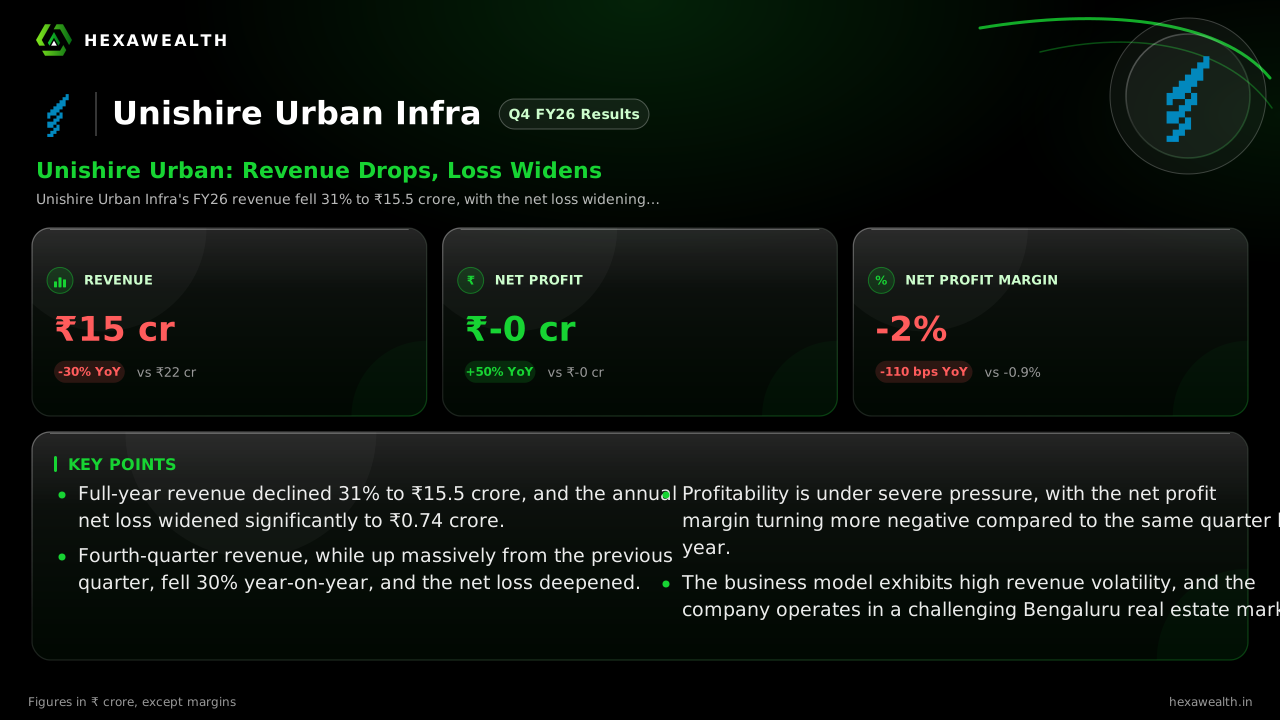
Unishire Urban Infra's FY26 revenue fell 31% to ₹15.5 crore, with the net loss widening to ₹0.74 crore. The Q4 performance showed a large sequential revenue jump but a deeper loss, highlighting ongoing operational challenges.
For a real estate developer, a sharp drop in annual revenue alongside a widening loss points to a fundamental challenge in project execution and sales. Unishire Urban Infra's FY26 results reveal exactly that, with the fourth quarter providing a stark snapshot of a business struggling to convert sporadic sales into consistent profits.
The numbers show a company in flux. Annual revenue fell 31% to ₹15.5 crore, while the net loss widened to ₹0.74 crore. The fourth quarter saw revenue of ₹15.38 crore, a massive jump from the near-zero sales of the previous quarter but still 30% lower than the same period last year. The quarter ended with a loss of ₹0.3 crore.
Revenue & profit
Revenue (₹ Cr)
Profit (₹ Cr)
- Revenue (₹ Cr), Q4 FY24: 1.84
- Revenue (₹ Cr), Q2 FY25: 0.36
- Revenue (₹ Cr), Q4 FY25: 22.06
- Revenue (₹ Cr), Q2 FY26: 0.13
- Revenue (₹ Cr), Q4 FY26: 15.38
- Profit (₹ Cr), Q4 FY24: 0.44
- Profit (₹ Cr), Q2 FY25: 0.18
- Profit (₹ Cr), Q4 FY25: -0.20
- Profit (₹ Cr), Q2 FY26: -0.44
- Profit (₹ Cr), Q4 FY26: -0.30
Revenue (₹ Cr)
- Revenue (₹ Cr), Q4 FY24: 1.84
- Revenue (₹ Cr), Q2 FY25: 0.36
- Revenue (₹ Cr), Q4 FY25: 22.06
- Revenue (₹ Cr), Q2 FY26: 0.13
- Revenue (₹ Cr), Q4 FY26: 15.38
Profit (₹ Cr)
- Profit (₹ Cr), Q4 FY24: 0.44
- Profit (₹ Cr), Q2 FY25: 0.18
- Profit (₹ Cr), Q4 FY25: -0.20
- Profit (₹ Cr), Q2 FY26: -0.44
- Profit (₹ Cr), Q4 FY26: -0.30
Net Profit Margin (%)
- Net Profit Margin (%), Q4 FY24: 23.9
- Net Profit Margin (%), Q2 FY25: 50.0
- Net Profit Margin (%), Q4 FY25: -0.9
- Net Profit Margin (%), Q2 FY26: -
- Net Profit Margin (%), Q4 FY26: -2.0
| Metric | CurrentQ4 FY26 | Same quarter LYQ4 FY25 |
|---|---|---|
| Revenue (₹ Cr) | 15.38YoY -30% | 22.06 |
| Profit (₹ Cr) | -0.30YoY -50% | -0.20 |
| Net Profit Margin (%) | -2.0YoY -122% | -0.9 |
The Volatility Behind the Numbers
The extreme quarter-on-quarter revenue surge, over 11,000%, underscores the project-based, lumpy nature of real estate income. The company's revenue stream is not steady but depends on the timing of property sales and project completions. This volatility makes it difficult to achieve consistent profitability, as seen in the swing from a small profit in Q2 FY25 to losses in subsequent periods.
A key pressure point is the operating margin. Data from Cruxal shows the company posted an operating loss in Q4. With other income falling to zero, the business lacked a cushion to offset its core operational costs. This squeezed the net profit margin, which worsened to -2.0% from -0.9% a year ago.
A Challenging Backdrop and Future Path
The external environment adds to the strain. A JLL report notes Bengaluru's residential sales declined 6% quarter-on-quarter in Q2 2026, with developers shifting focus to premium segments. For a smaller player like Unishire, competing in a market where buyer preferences are changing and costs are rising is an uphill task.
Live Chart
· UNISHIRE
(BSE)
ISIN: INE210P01015
Management has signaled that consistent growth and margin expansion are strategic priorities for FY27, according to a report from Univest. However, with no clear visibility on new project launches or a robust order book, the path to achieving this remains uncertain. The company also faces governance questions, with a director resigning over unpaid fees, as reported by InvestorFeed.
Key Points
- Full-year revenue declined 31% to ₹15.5 crore, and the annual net loss widened significantly to ₹0.74 crore.
- Fourth-quarter revenue, while up massively from the previous quarter, fell 30% year-on-year, and the net loss deepened.
- Profitability is under severe pressure, with the net profit margin turning more negative compared to the same quarter last year.
- The business model exhibits high revenue volatility, and the company operates in a challenging Bengaluru real estate market.
Hexa Perspective
The quarter confirms Unishire Urban Infra is caught in a cycle of inconsistent sales and an inability to control costs relative to revenue. The annual figures paint a clearer picture of deterioration than the noisy quarterly jump.
For the stock, the investment case hinges on a visible pipeline of new projects and a return to sustained, profitable sales. Until there is concrete evidence of that, the company's financials are likely to remain volatile and under pressure.
Also read
Want this applied to your portfolio?
Talk to a HexaWealth advisor, or sync your mutual fund data for insights tailored to your holdings.