Tenneco (TENNIND) Q2 FY27 India's Q2 Revenue Jumps 34% as Profit Growth Lags
The auto ancillary leader posted its highest-ever quarterly revenue, but margin compression from commodity costs held profit growth to a more modest 15%.
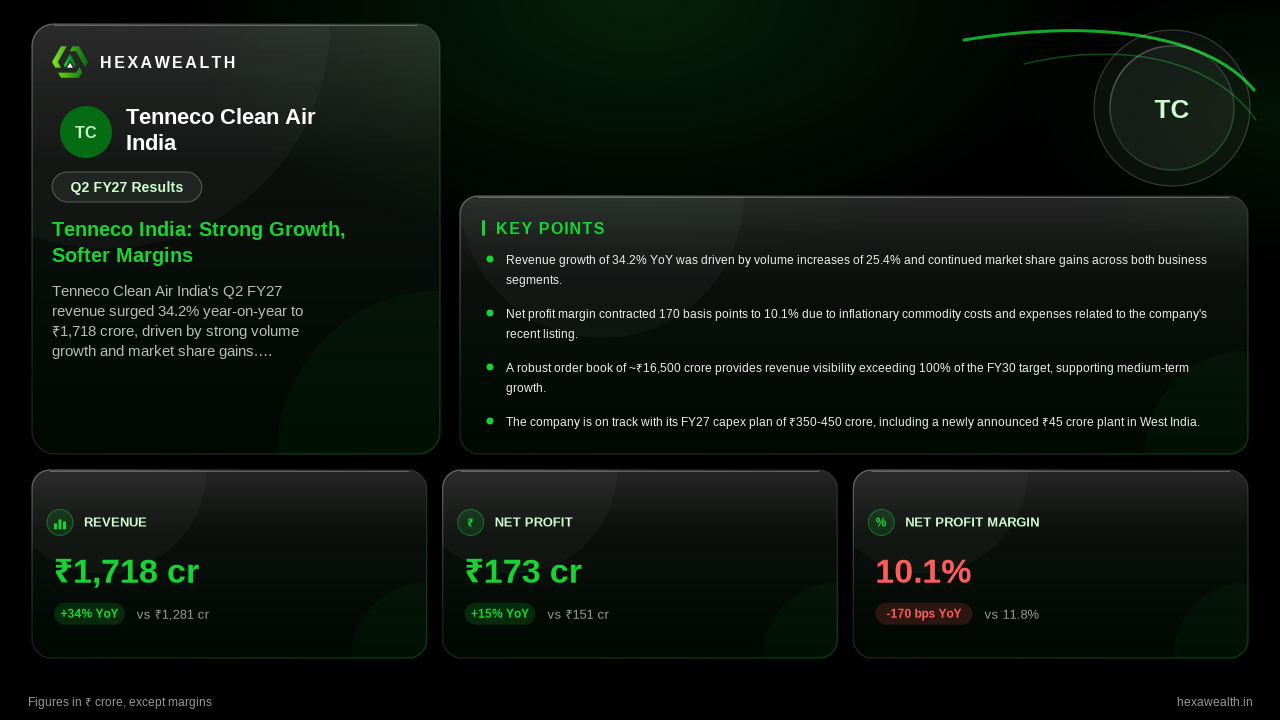
Tenneco Clean Air India's Q2 FY27 revenue surged 34.2% year-on-year to ₹1,718 crore, driven by strong volume growth and market share gains. However, net profit grew only 15.1% as margins were squeezed by inflationary pressures.
For a company whose fortunes are tied to vehicle production, Tenneco Clean Air India’s September quarter delivered exactly the kind of top-line momentum investors watch for. Revenue hit a record ₹1,718 crore, up 34% from a year ago, as the company rode a wave of market share gains and new customer wins. Yet, the bottom line told a more complex story, with profit growth of 15% lagging significantly behind, highlighting a persistent margin squeeze.
The numbers show a business scaling rapidly but facing cost headwinds. Net profit for Q2 FY27 was ₹173 crore, a 15.1% increase year-on-year. Sequentially, revenue grew 11.2% while profit inched up 4.9%. The net profit margin contracted 170 basis points from last year to 10.1%, reflecting the pressure.
Revenue & profit
Revenue (₹ Cr)
Profit (₹ Cr)
- Revenue (₹ Cr), Q2 FY26: 1,280.64
- Revenue (₹ Cr), Q3 FY26: 1,285.26
- Revenue (₹ Cr), Q4 FY26: 1,552.45
- Revenue (₹ Cr), Q1 FY27: 1,544.75
- Revenue (₹ Cr), Q2 FY27: 1,718.34
- Profit (₹ Cr), Q2 FY26: 150.68
- Profit (₹ Cr), Q3 FY26: 118.81
- Profit (₹ Cr), Q4 FY26: 166.78
- Profit (₹ Cr), Q1 FY27: 165.24
- Profit (₹ Cr), Q2 FY27: 173.36
Revenue (₹ Cr)
- Revenue (₹ Cr), Q2 FY26: 1,280.64
- Revenue (₹ Cr), Q3 FY26: 1,285.26
- Revenue (₹ Cr), Q4 FY26: 1,552.45
- Revenue (₹ Cr), Q1 FY27: 1,544.75
- Revenue (₹ Cr), Q2 FY27: 1,718.34
Profit (₹ Cr)
- Profit (₹ Cr), Q2 FY26: 150.68
- Profit (₹ Cr), Q3 FY26: 118.81
- Profit (₹ Cr), Q4 FY26: 166.78
- Profit (₹ Cr), Q1 FY27: 165.24
- Profit (₹ Cr), Q2 FY27: 173.36
Net Profit Margin
- Net Profit Margin, Q2 FY26: 11.8%
- Net Profit Margin, Q3 FY26: 9.2%
- Net Profit Margin, Q4 FY26: 10.7%
- Net Profit Margin, Q1 FY27: 10.7%
- Net Profit Margin, Q2 FY27: 10.1%
| Metric | CurrentQ2 FY27 | PreviousQ1 FY27 | Same quarter LYQ2 FY26 |
|---|---|---|---|
| Revenue (₹ Cr) | 1,718.34YoY +34% | 1,544.75 | 1,280.64 |
| Profit (₹ Cr) | 173.36YoY +15% | 165.24 | 150.68 |
| Net Profit Margin | 10.1%YoY -14% | 10.7% | 11.8% |
Why Profits Didn't Keep Pace
The gap between revenue and profit growth was driven by costs that rose even faster. Total expenses jumped 35.8% year-on-year, outpacing the 34.2% revenue increase. Management, in the earnings call covered by AlphaStreet, pointed to inflationary headwinds from the Middle East situation as the primary culprit. These included sharp increases in prices of steel, lube oil, plastic, and rubber.
While steel costs are indexed and recoverable from customers with a lag, items like lube oil are non-indexed and subject to negotiation. The company’s Advanced Ride Technologies (ART) business, which saw value-added revenue surge 37.8%, was particularly impacted by these commodity spikes. Costs associated with operating as a newly listed public entity also contributed to the margin pressure.
A Growth Engine With Clear Visibility
Despite the margin challenge, the underlying demand story remains robust. Growth was broad-based, with the Clean Air & Powertrain division's value-added revenue up 26.6%. The company’s order book, a key indicator of future revenue, stands at approximately ₹16,500 crore, as reported by ETAuto. This covers more than 100% of its FY30 revenue target, providing strong visibility for a double-digit growth trajectory.
Live Chart
· TENNIND
(BSE)
ISIN: INE19RI01016
To meet this demand, the company is actively expanding capacity. It announced a new ₹45 crore Clean Air plant in West India, which will add 12-14% more hot-end capacity. This follows earlier announcements for plants in North India and for its ART business. Management maintains its full-year capital expenditure guidance of ₹350-450 crore for FY27.
The Market's Read and the Road Ahead
The market reaction acknowledged the mixed print. Analysts have largely maintained a positive stance, though with revised targets. Motilal Oswal Financial Services, for instance, reiterated a BUY rating but cut its target price to ₹655, citing slower export recovery and margin pressure, as noted by Investment Guru India. The core concern remains the duration of the margin squeeze.
Management expects some cost recovery through ongoing customer negotiations, but the timeline is uncertain. The upcoming quarters will test the company's ability to pass on inflationary costs while executing its capacity expansion to capitalize on a strong order book.
Key Points
- Revenue growth of 34.2% YoY was driven by volume increases of 25.4% and continued market share gains across both business segments.
- Net profit margin contracted 170 basis points to 10.1% due to inflationary commodity costs and expenses related to the company's recent listing.
- A robust order book of ~₹16,500 crore provides revenue visibility exceeding 100% of the FY30 target, supporting medium-term growth.
- The company is on track with its FY27 capex plan of ₹350-450 crore, including a newly announced ₹45 crore plant in West India.
Hexa Perspective
Tenneco India's quarter illustrates the classic tension between scaling a business and preserving its profitability. The company is successfully capturing market share in a growing automotive market, evidenced by record revenue and a formidable order book. However, its margins are being tested by external cost pressures that are not fully within its control. The investment case now hinges on the resolution of this margin pressure. Success in recovering non-indexed commodity costs from OEMs and a favorable shift in product mix towards higher-margin hot-end systems could restore earnings quality. Until then, strong top-line growth may continue to deliver only modest bottom-line expansion.
Also read
Want this applied to your portfolio?
Talk to a HexaWealth advisor, or sync your mutual fund data for insights tailored to your holdings.