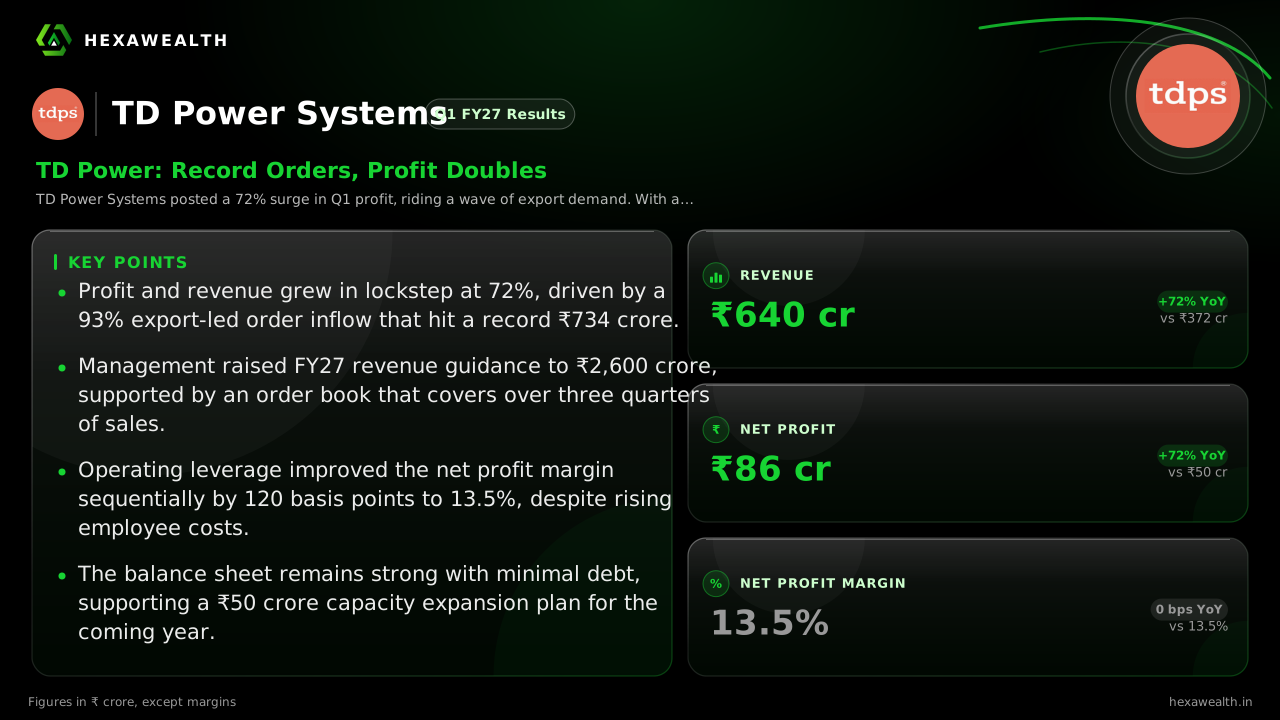
TD Power Systems posted a 72% surge in Q1 profit, riding a wave of export demand. With a record order book and raised revenue guidance, the company is expanding capacity to meet a global power equipment upcycle.
For a company that builds the heart of power plants, the global rush for electricity is translating directly into its order book. TD Power Systems’ June quarter shows that translation in full force, with profit and revenue both rising 72% year-on-year.
The numbers tell a story of scale. Revenue reached ₹640 crore, while net profit hit ₹86.3 crore. The net profit margin held steady at 13.5% year-on-year, but improved sequentially by 120 basis points as operating leverage kicked in.
Revenue & profit
Revenue (₹ Cr)
Profit (₹ Cr)
Revenue (₹ Cr), Q1 FY26 (Jun 2025): 371.90
Revenue (₹ Cr), Q2 FY26 (Sep 2025): 452.46
Revenue (₹ Cr), Q3 FY26 (Dec 2025): 442.68
Revenue (₹ Cr), Q4 FY26 (Mar 2026): 589.19
Revenue (₹ Cr), Q1 FY27 (Jun 2026): 640.05
Profit (₹ Cr), Q1 FY26 (Jun 2025): 50.07
Profit (₹ Cr), Q2 FY26 (Sep 2025): 60.19
Profit (₹ Cr), Q3 FY26 (Dec 2025): 56.32
Profit (₹ Cr), Q4 FY26 (Mar 2026): 72.19
Profit (₹ Cr), Q1 FY27 (Jun 2026): 86.29
Revenue (₹ Cr)
Revenue (₹ Cr), Q1 FY26 (Jun 2025): 371.90
Revenue (₹ Cr), Q2 FY26 (Sep 2025): 452.46
Revenue (₹ Cr), Q3 FY26 (Dec 2025): 442.68
Revenue (₹ Cr), Q4 FY26 (Mar 2026): 589.19
Revenue (₹ Cr), Q1 FY27 (Jun 2026): 640.05
Profit (₹ Cr)
Profit (₹ Cr), Q1 FY26 (Jun 2025): 50.07
Profit (₹ Cr), Q2 FY26 (Sep 2025): 60.19
Profit (₹ Cr), Q3 FY26 (Dec 2025): 56.32
Profit (₹ Cr), Q4 FY26 (Mar 2026): 72.19
Profit (₹ Cr), Q1 FY27 (Jun 2026): 86.29
Net Profit Margin (%)
Net Profit Margin (%), Q1 FY26 (Jun 2025): 13.5
Net Profit Margin (%), Q2 FY26 (Sep 2025): 13.3
Net Profit Margin (%), Q3 FY26 (Dec 2025): 12.7
Net Profit Margin (%), Q4 FY26 (Mar 2026): 12.3
Net Profit Margin (%), Q1 FY27 (Jun 2026): 13.5
Metric
CurrentQ1 FY27 (Jun 2026)
PreviousQ4 FY26 (Mar 2026)
Revenue (₹ Cr)
640.05
589.19
Profit (₹ Cr)
86.29
72.19
Net Profit Margin (%)
13.5
12.3
Why the Export Engine Fired
The surge was powered by exports, which made up 93% of the quarter’s record ₹734 crore order inflow. According to management, demand from US data centres, grid stabilisation projects and renewable integration is creating a global shortage of generators. This allowed TD Power to execute 320 units and implement price increases.
The margin held firm despite a 22.5% sequential jump in employee costs, as the company hired to support growth. A report by Anand Rathi notes that price-variation clauses with customers helped pass through higher input costs for copper and steel.
The Runway Is Long
The order book swelled to ₹2,207 crore, providing over three quarters of revenue visibility. Management, citing confidence from non-refundable customer advances, raised its FY27 revenue guidance to ₹2,600 crore. It plans ₹50 crore in debottlenecking capex to reach a ₹3,200 crore annual revenue capacity by FY28.
Live Chart
· TDPOWERSYS
(BSE)
ISIN: INE419M01035
Broker reaction was positive. Anand Rathi upgraded the stock to ‘BUY’ with a target of ₹1,751, citing strong cash flow visibility. It noted, however, that valuation remains demanding at over 62 times FY27 estimated earnings.
The main challenge is execution. Working capital is absorbing cash as receivables and inventory grow with sales. Yet, with a near debt-free balance sheet and a CRISIL AA- rating, the company is well-placed to fund its expansion.
Key Points
Profit and revenue grew in lockstep at 72%, driven by a 93% export-led order inflow that hit a record ₹734 crore.
Management raised FY27 revenue guidance to ₹2,600 crore, supported by an order book that covers over three quarters of sales.
Operating leverage improved the net profit margin sequentially by 120 basis points to 13.5%, despite rising employee costs.
The balance sheet remains strong with minimal debt, supporting a ₹50 crore capacity expansion plan for the coming year.
“
Hexa Perspective
This quarter confirms TD Power is a direct beneficiary of a sustained global power equipment upcycle. The quality of growth is high, with margins protected by pricing power and operating leverage.
The key question is duration. Management’s confidence, backed by customer advances and a 10-year framework with Siemens Energy, suggests this cycle has legs. Execution on capacity expansion and working capital management will determine how much of the demand converts into sustained shareholder returns.
Talk to a HexaWealth advisor, or sync your mutual fund data for insights tailored to your holdings.
Frequently asked questions
What were TD Power Systems' Q1 FY27 results?
TD Power Systems reported a 72.3% year-on-year increase in consolidated net profit to ₹86.29 crore for Q1 FY27 (June 2026 quarter). Revenue from operations grew 72.1% to ₹640.05 crore. The net profit margin was stable at 13.5%.
Why did TD Power Systems' Q1 profit jump 72%?
TD Power's profit surge was driven by explosive export demand, particularly for generators used in US data centres and grid projects. The company executed 320 generators and benefited from price increases, leading to a 72.1% revenue growth that flowed directly to the bottom line.
What is TD Power Systems' order book position in Q1 FY27?
As of June 30, 2026, TD Power Systems' order book stood at ₹2,207.30 crore, a 50% increase year-on-year. This provides visibility for over three quarters of revenue at the current run rate, with exports comprising about 70% of the backlog.
What was TD Power Systems' Q1 FY27 order inflow?
TD Power's Q1 FY27 order inflow was ₹734.10 crore, a massive 87% increase year-on-year. Exports accounted for 93% of this inflow, which management described as the company's highest-ever quarterly order intake.
Did TD Power Systems beat analyst estimates for Q1 FY27?
Yes, TD Power's results significantly exceeded broker estimates. According to Anand Rathi Research, reported revenue of ₹640.05 crore beat its estimate of ₹478 crore, while the net profit of ₹86.29 crore surpassed its ₹65 crore forecast.
What is TD Power Systems' FY27 revenue guidance after Q1 results?
Following the strong Q1, TD Power Systems raised its FY27 revenue guidance to ₹2,600 crore. This is an increase from the earlier guidance of more than ₹2,400 crore and reflects management's confidence in the robust order pipeline.
What are TD Power Systems' capacity expansion plans?
TD Power plans to spend about ₹50 crore in FY27 on debottlenecking to increase its annual revenue capacity to approximately ₹3,200 crore by FY28. It is also evaluating a further expansion to exceed ₹4,000 crore capacity by FY29 or FY30.
How did TD Power Systems manage margins despite cost pressures?
TD Power maintained its net profit margin through price-variation clauses with customers, which helped pass through higher costs of raw materials like copper and steel. Operating leverage from higher volumes also supported a 120 basis point sequential improvement in margin.
What was the broker reaction to TD Power Systems' Q1 FY27 results?
Anand Rathi Research upgraded TD Power Systems to 'BUY' with a target price of ₹1,751, citing strong execution and improved earnings visibility. The broker raised its estimates, noting the global power-equipment upcycle is translating into near-term profits.
What is driving export demand for TD Power Systems?
Export demand is driven by a global shortage of power generation equipment, fueled by US data centre expansion, grid stabilisation projects, and renewable energy integration. Management notes that leading global turbine and engine makers are placing large, repeat orders.
TD Power Systems Q1 FY27 results August 2026
TD Power Systems announced its Q1 FY27 results on August 14, 2026. For the quarter ended June 2026, consolidated revenue was ₹640.05 crore and net profit was ₹86.29 crore, representing year-on-year growth of over 72% for both metrics.
Why did TD Power Systems' other income fall in Q1 FY27?
TD Power's other income fell 67.6% sequentially to ₹2.62 crore in Q1 FY27. This decline from ₹8.08 crore in Q4 FY26 is attributed to lower treasury income, making the quarter's profit growth even more reliant on strong operational performance.
What is TD Power Systems' working capital position?
Working capital is under pressure as the business scales. Reports indicate receivables were about ₹785 crore and inventory about ₹569 crore as of June 2026. Management has said it cannot significantly alter customer payment terms without risking business.
TD Power Systems shareholding pattern Q1 FY27
As of June 2026, promoter holding in TD Power Systems was stable at 26.9%. Foreign Institutional Investors (FIIs) held 26.2%, while Domestic Institutional Investors (DIIs) increased their stake to 23.9%, reflecting growing institutional interest.