All posts

Follow Us

LinkedInInstagramX
Quarterly ResultsArchiveLast updated 6 November 20263 min read

Riddhi Steel & Tube (RSTL) Q2 FY27 Profit Falls 33% as Revenue Crashes 45%

The steel pipe maker's quarterly revenue fell to a two-year low, though cost cuts kept its net profit margin from collapsing.

By Vinayak Gandhi, CFA · Created 6 November 2026

Riddhi Steel & Tube's Q2 FY27 revenue plunged 45% year-on-year to ₹137 crore. Net profit fell 33% to ₹4 crore, but the company's net profit margin improved slightly due to aggressive expense reduction.

For a steel pipe maker, revenue is a direct read on steel prices and the volume of metal moving through its plant. Riddhi Steel & Tube’s September quarter shows both readings turned sharply negative, with sales crashing to a two-year low of ₹137 crore. While profit followed sales down, aggressive cost-cutting kept the company’s thin margin from disappearing entirely.

The numbers tell a story of deep contraction. Revenue fell 45% from a year ago and 35% from the previous quarter. Net profit dropped 33% year-on-year to ₹4 crore. The only positive was a 50-basis-point lift in the net profit margin to 2.9%, a small win in a brutal quarter.

Revenue & profit

Revenue (₹ Cr)

Profit (₹ Cr)

Revenue & profitQ2 FY25 155.0, Q4 FY25 237.0, Q2 FY26 247.0, Q4 FY26 211.0, Q2 FY27 137.0. Q2 FY25 3.0, Q4 FY25 4.0, Q2 FY26 6.0, Q4 FY26 5.0, Q2 FY27 4.00100200300400Q2 '25Q4 '25Q2 '26Q4 '26Q2 '27
  • Revenue (₹ Cr), Q2 FY25: 155.0
  • Revenue (₹ Cr), Q4 FY25: 237.0
  • Revenue (₹ Cr), Q2 FY26: 247.0
  • Revenue (₹ Cr), Q4 FY26: 211.0
  • Revenue (₹ Cr), Q2 FY27: 137.0
  • Profit (₹ Cr), Q2 FY25: 3.0
  • Profit (₹ Cr), Q4 FY25: 4.0
  • Profit (₹ Cr), Q2 FY26: 6.0
  • Profit (₹ Cr), Q4 FY26: 5.0
  • Profit (₹ Cr), Q2 FY27: 4.0

Revenue (₹ Cr)

Revenue (₹ Cr)Q2 FY25 155.0, Q4 FY25 237.0, Q2 FY26 247.0, Q4 FY26 211.0, Q2 FY27 137.00100200300400Q2 '25Q4 '25Q2 '26Q4 '26Q2 '27
  • Revenue (₹ Cr), Q2 FY25: 155.0
  • Revenue (₹ Cr), Q4 FY25: 237.0
  • Revenue (₹ Cr), Q2 FY26: 247.0
  • Revenue (₹ Cr), Q4 FY26: 211.0
  • Revenue (₹ Cr), Q2 FY27: 137.0

Profit (₹ Cr)

Profit (₹ Cr)Q2 FY25 3.0, Q4 FY25 4.0, Q2 FY26 6.0, Q4 FY26 5.0, Q2 FY27 4.002468Q2 '25Q4 '25Q2 '26Q4 '26Q2 '27
  • Profit (₹ Cr), Q2 FY25: 3.0
  • Profit (₹ Cr), Q4 FY25: 4.0
  • Profit (₹ Cr), Q2 FY26: 6.0
  • Profit (₹ Cr), Q4 FY26: 5.0
  • Profit (₹ Cr), Q2 FY27: 4.0

Net Profit Margin

Net Profit MarginQ2 FY25 1.9%, Q4 FY25 1.7%, Q2 FY26 2.4%, Q4 FY26 2.4%, Q2 FY27 2.9%0%1%2%3%4%Q2 '25Q4 '25Q2 '26Q4 '26Q2 '27
  • Net Profit Margin, Q2 FY25: 1.9%
  • Net Profit Margin, Q4 FY25: 1.7%
  • Net Profit Margin, Q2 FY26: 2.4%
  • Net Profit Margin, Q4 FY26: 2.4%
  • Net Profit Margin, Q2 FY27: 2.9%
MetricCurrentQ2 FY27Same quarter LYQ2 FY26
Revenue (₹ Cr)
137.0YoY -45%
247.0
Profit (₹ Cr)
4.0YoY -33%
6.0
Net Profit Margin
2.9%YoY +21%
2.4%

Why the top line collapsed

Riddhi Steel’s business is a simple margin between the price it pays for steel coil and what dealers pay for finished pipe. A report from newboard.in notes the company has little pricing power, with pipe prices simply following steel. This quarter, that link worked against it. While official data from the Press Information Bureau shows national finished steel consumption grew 7.7% in September, Riddhi’s revenue moved in the opposite direction, suggesting it lost significant market volume.

The cost cut that saved the margin

Total expenses fell 45%, nearly matching the revenue drop. This disciplined pullback, as reported by scanx.trade, prevented a worse profit outcome. However, the cost of materials fell only 33%, squeezing gross margins. More worryingly, finance costs rose 10% year-on-year despite lower sales, a sign that debt taken on to fund a large inventory is becoming a heavier burden.

A debt-heavy balance sheet

That debt is the quarter’s lasting concern. The company’s debt-to-equity ratio stands at 2.23, and scanx.trade reports long-term borrowings jumped over 55% in just six months. With operating cash flow deeply negative due to rising inventory and receivables, the interest burden will pressure any recovery. The company provides no order book, offering little visibility on when sales might rebound.

Live Chart

· RSTL

(BSE)

ISIN: INE367U01013

Key Points

  • Revenue fell 45% year-on-year to ₹137 crore, the lowest quarterly sales in two years.
  • Net profit declined 33% to ₹4 crore, but net profit margin improved slightly to 2.9% on aggressive cost cuts.
  • Finance costs rose 10% despite lower revenue, highlighting a growing debt-servicing burden.
  • Operating cash flow turned sharply negative as working capital swelled with inventory and receivables.

Hexa Perspective

This quarter underscores Riddhi Steel’s vulnerability as a price-taker in a volatile commodity cycle. The margin hold is a tactical win, but it comes from cutting costs, not operational strength. The real test is whether steel prices and demand recover before the high debt and negative cash flow strain the business further. Without an order book or clear capacity expansion plans, the path to regaining last year’s sales level looks uncertain and heavily dependent on a broader steel market rebound.

Share or follow HexaWealth

Also read

Want this applied to your portfolio?

Talk to a HexaWealth advisor, or sync your mutual fund data for insights tailored to your holdings.
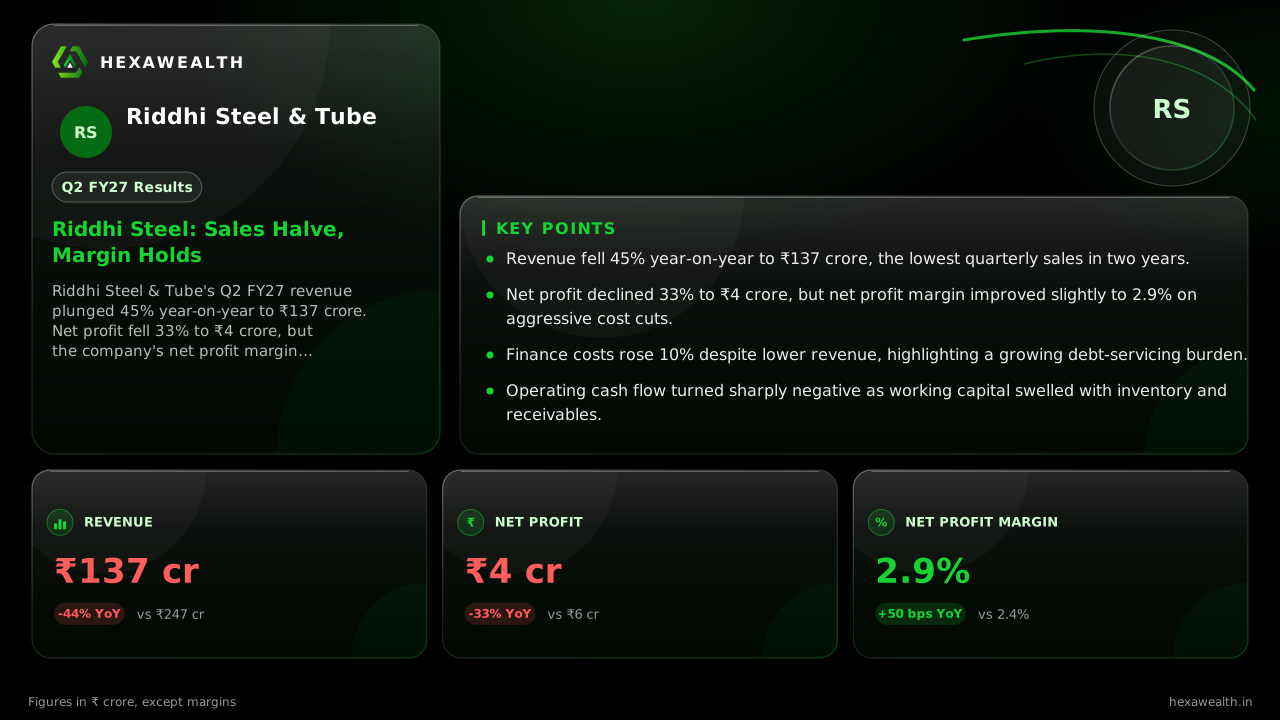
Riddhi Steel & Tube (RSTL) Q2 FY27 results, revenue and profits.

Frequently asked questions

What were Riddhi Steel & Tube's Q2 FY27 results?
Riddhi Steel & Tube reported Q2 FY27 revenue of ₹137 crore, a 45% year-on-year decline. Net profit for the September 2026 quarter was ₹4 crore, down 33% from the same period last year. The net profit margin, however, improved slightly to 2.9%.
Why did Riddhi Steel & Tube's revenue fall 44.5% year-on-year in Q2 FY27?
Riddhi Steel's revenue fell sharply primarily because pipe prices follow steel prices, and the company has little pricing power. A report from newboard.in suggests it likely lost significant sales volume, as its performance contrasted with broader growth in national steel consumption during the period.
What drove the improvement in Riddhi Steel & Tube's net profit margin to 2.9% despite the revenue crash?
The margin improvement to 2.9% was driven by aggressive cost-cutting. Total expenses fell 45% year-on-year, nearly matching the revenue decline. However, scanx.trade reported that material costs fell less than sales, squeezing gross margins, while finance costs actually rose.
What is the status of Riddhi Steel & Tube's high debt-to-equity ratio and its interest burden?
Riddhi Steel's debt-to-equity ratio is 2.23, indicating high leverage. According to scanx.trade, long-term borrowings surged over 55% between March and September 2026. Finance costs rose 10% year-on-year in H1 FY27 despite lower revenue, increasing the debt-servicing burden.
What guidance did Riddhi Steel & Tube management provide for future quarters?
The company's filings and results announcement did not include specific financial guidance or forward-looking commentary for future quarters. The management has not disclosed an order book, which limits visibility into near-term sales recovery.
What is the current demand and pricing environment for steel pipes and tubes in India affecting Riddhi Steel?
Official data from the Press Information Bureau shows India's finished steel consumption grew 7.7% in September 2026, with hot-rolled coil prices up over 31% year-on-year. This suggests a healthy broader market, implying Riddhi Steel's severe revenue drop may be company-specific, related to volume loss or competitive pressures.
What are Riddhi Steel & Tube's capex plans and new plant setup projects for FY27?
Public filings and recent results announcements do not detail specific new capex plans or plant setup projects for FY27. A business analysis by newboard.in notes the company provides no expansion plan or order book in its documents.
Did Riddhi Steel & Tube's Q2 FY27 results beat or miss analyst estimates?
There is no available consensus of analyst estimates to compare against for Riddhi Steel & Tube's Q2 FY27 results. The company's performance is best evaluated against its own historical trends, which show a significant decline.
Are institutional investors increasing or decreasing their stake in Riddhi Steel & Tube recently?
Domestic institutional investors (DIIs) held a 1.38% stake in Riddhi Steel & Tube as of September 2026, unchanged from March 2026. Foreign institutional investors (FIIs) held 0%. Promoter holding increased slightly to 74.72%.
What are the key concerns or scepticism analysts have about Riddhi Steel & Tube's business model and outlook?
Analysis from newboard.in highlights key concerns: the company has little pricing power, carries a large inventory funded by debt, and provides no order book for visibility. Its high debt-to-equity ratio of 2.23 and rising finance costs are also significant financial risks.
Riddhi Steel H1FY27 net profit down 42% YoY to ₹354 lakh
Riddhi Steel & Tube's net profit for the half-year ended September 2026 (H1FY27) was ₹3.54 crore, marking a 42% decline from ₹6.08 crore in H1FY26. This was driven by a 44% contraction in revenue to ₹13.71 crore, as reported by scanx.trade.
Riddhi Steel and Tube share price, results, shareholding and key points
As of late October 2026, Riddhi Steel & Tube's share price was around ₹275. For Q2 FY27, it reported revenue of ₹137 crore and profit of ₹4 crore. Promoter holding was 74.72% as of September 2026, with a market capitalisation of approximately ₹342 crore.