Rajgor Castor Derivatives (RCDL) Q2 FY27 Profit Slumps 62% as Revenue Retreats from Peak
The castor oil processor's profit fell sharply from a record March quarter, highlighting the volatility of its thin-margin commodity business.
Rajgor Castor Derivatives posted a 43% yearly revenue jump but profit plunged 62% from the prior quarter. The retreat from a peak highlights the volatility in its low-margin, commodity-driven business model.
For a processor of castor oil, revenue swings with crop prices and order timing, not just volumes. Rajgor Castor's September quarter showed that reality, with sales pulling back 33% from a record March period and profit falling even faster.
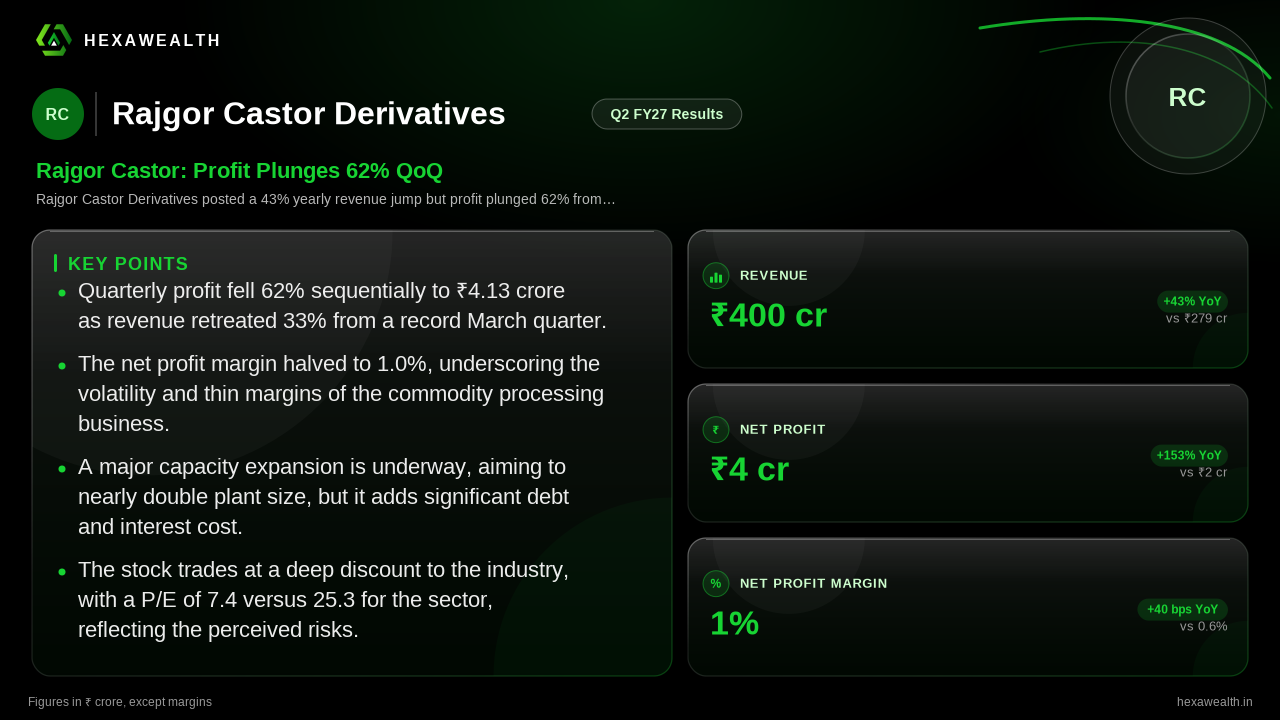
The numbers tell a story of retreat from a peak. Revenue of ₹400 crore was up 43% from a soft year-ago quarter but down sharply from ₹593 crore in Q4 FY26. Profit of ₹4.13 crore fell 62% sequentially, and the net profit margin halved to 1.0%.
Revenue & profit
Revenue (₹ Cr)
Profit (₹ Cr)
- Revenue (₹ Cr), Sep 2023 (Q2 FY24): 77.93
- Revenue (₹ Cr), Mar 2025 (Q4 FY25): 347.49
- Revenue (₹ Cr), Sep 2025 (Q2 FY26): 278.97
- Revenue (₹ Cr), Mar 2026 (Q4 FY26): 593.23
- Revenue (₹ Cr), Sep 2026 (Q2 FY27): 400.01
- Profit (₹ Cr), Sep 2023 (Q2 FY24): 1.44
- Profit (₹ Cr), Mar 2025 (Q4 FY25): 7.29
- Profit (₹ Cr), Sep 2025 (Q2 FY26): 1.63
- Profit (₹ Cr), Mar 2026 (Q4 FY26): 10.99
- Profit (₹ Cr), Sep 2026 (Q2 FY27): 4.13
Revenue (₹ Cr)
- Revenue (₹ Cr), Sep 2023 (Q2 FY24): 77.93
- Revenue (₹ Cr), Mar 2025 (Q4 FY25): 347.49
- Revenue (₹ Cr), Sep 2025 (Q2 FY26): 278.97
- Revenue (₹ Cr), Mar 2026 (Q4 FY26): 593.23
- Revenue (₹ Cr), Sep 2026 (Q2 FY27): 400.01
Profit (₹ Cr)
- Profit (₹ Cr), Sep 2023 (Q2 FY24): 1.44
- Profit (₹ Cr), Mar 2025 (Q4 FY25): 7.29
- Profit (₹ Cr), Sep 2025 (Q2 FY26): 1.63
- Profit (₹ Cr), Mar 2026 (Q4 FY26): 10.99
- Profit (₹ Cr), Sep 2026 (Q2 FY27): 4.13
Net Profit Margin
- Net Profit Margin, Sep 2023 (Q2 FY24): 1.8%
- Net Profit Margin, Mar 2025 (Q4 FY25): 2.1%
- Net Profit Margin, Sep 2025 (Q2 FY26): 0.6%
- Net Profit Margin, Mar 2026 (Q4 FY26): 1.9%
- Net Profit Margin, Sep 2026 (Q2 FY27): 1.0%
| Metric | CurrentSep 2026 (Q2 FY27) | PreviousMar 2026 (Q4 FY26) |
|---|---|---|
| Revenue (₹ Cr) | 400.01 | 593.23 |
| Profit (₹ Cr) | 4.13 | 10.99 |
| Net Profit Margin | 1.0% | 1.9% |
Why the March quarter was the outlier
That record ₹593 crore revenue in March appears to have been an exceptional surge. Analysis from newboard.in notes the company operates on a purchase-order basis without long-term contracts, making quarterly sales lumpy. The sequential drop suggests the March period benefited from a concentration of orders and potentially higher traded goods sales, which swell revenue but add little profit.
The thin margin that got thinner
The business model itself keeps profitability low. As the rating agency Infomerics noted in a February report cited by newboard.in, profitability is exposed to castor seed and oil prices, with margins staying moderate. The quarterly margin compression from 1.9% to 1.0% shows how quickly pricing shifts or a less favourable sales mix can erase earnings.
Costs did not fall as fast as revenue. While employee and interest expenses dropped, the total expense line fell 31%, less than the 33% drop in sales. This operating leverage works in reverse when volumes dip. A surge in other income, up over 4,300% year-on-year to ₹6.51 crore, provided a critical boost to the bottom line but is unlikely to be a recurring feature.
Live Chart
· RCDL
(BSE)
ISIN: INE0BZQ01011
Betting on a new plant for growth
The company's stated growth path is a major capacity expansion. In September, it announced a new 348-tonne-per-day plant for derivative products, as reported by Law of Investing. The ₹61.5 crore project, funded by a term loan and internal accruals, aims to raise total capacity by 77% to 798 tonnes per day within about ten months.
This expansion into higher-value derivatives is a strategic shift from basic oil. However, it adds financial risk. Analysis from Flash Finance warns the new term loan from Jana Small Finance Bank will bring substantial interest costs, estimated at ₹4.5–5.0 crore annually, onto a balance sheet where working capital needs are already high.
Key Points
- Quarterly profit fell 62% sequentially to ₹4.13 crore as revenue retreated 33% from a record March quarter.
- The net profit margin halved to 1.0%, underscoring the volatility and thin margins of the commodity processing business.
- A major capacity expansion is underway, aiming to nearly double plant size, but it adds significant debt and interest cost.
- The stock trades at a deep discount to the industry, with a P/E of 7.4 versus 25.3 for the sector, reflecting the perceived risks.
Hexa Perspective
Rajgor Castor's quarter illustrates the core tension of its business: impressive yearly growth rates can mask severe quarterly volatility driven by commodity cycles and order timing. The planned expansion into derivatives is a necessary move to capture more value, but execution risk is high. Investors are weighing the growth potential of a nearly doubled capacity against a stretched balance sheet, rising interest costs, and a history of wafer-thin margins. The stock's deep valuation discount suggests the market is pricing in these execution challenges until the new plant proves it can deliver steadier, more profitable growth.
Also read
Want this applied to your portfolio?
Talk to a HexaWealth advisor, or sync your mutual fund data for insights tailored to your holdings.