Mukand (MUKANDLTD) Q2 FY27 Profit Crashes 93% as One-Off Land Sale Fades
Mukand's September quarter profit fell 92.5% sequentially as a large land sale gain from the prior quarter disappeared, revealing a thin core margin.
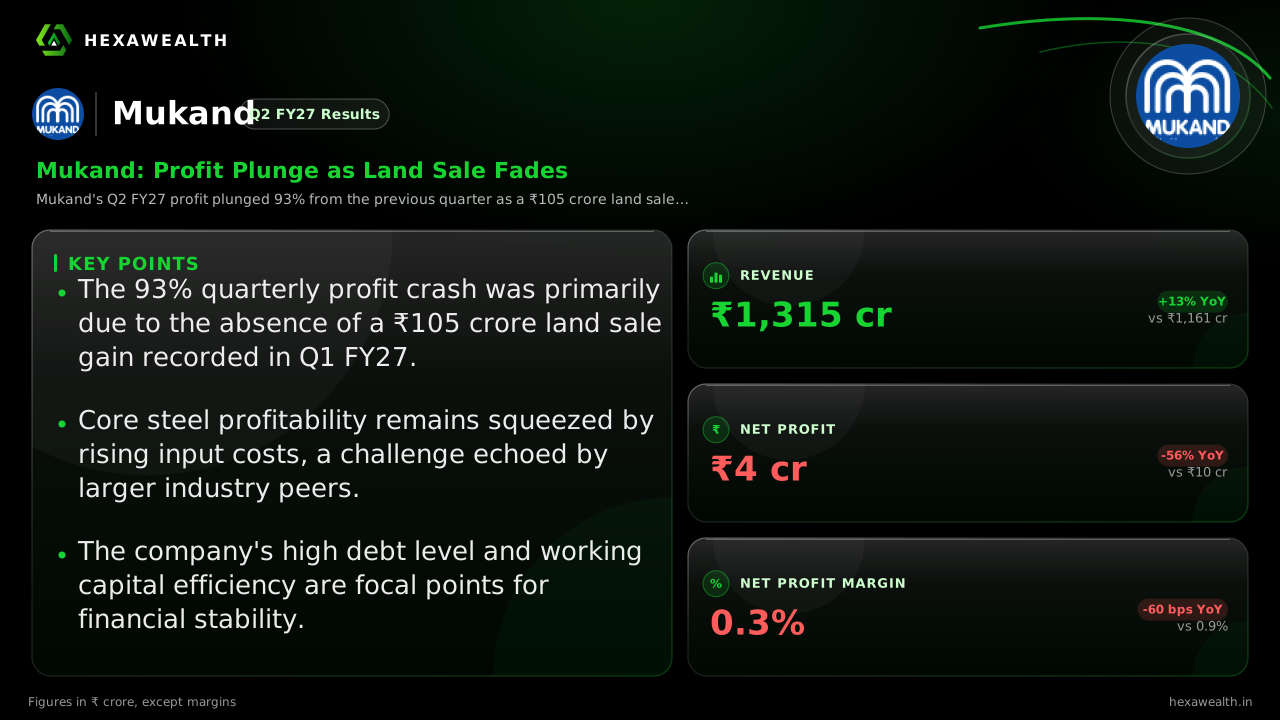
Mukand's Q2 FY27 profit plunged 93% from the previous quarter as a ₹105 crore land sale gain faded. Revenue grew 13.3% year-on-year, but core profitability remains under pressure from rising raw material costs.
For Mukand, the September quarter was a reality check. The specialty steelmaker's headline revenue grew, but its profit collapsed as a one-off land sale that flattered the previous quarter's earnings disappeared.
Revenue for Q2 FY27 came in at ₹1,315 crore, up 13.3% from a year ago. Yet net profit was just ₹4.3 crore, down 56.5% year-on-year and a steep 92.5% lower than the June quarter. The net profit margin shrank to a wafer-thin 0.3%.
Revenue & profit
Revenue (₹ Cr)
Profit (₹ Cr)
- Revenue (₹ Cr), Q2 FY26 (Sep 2025): 1,160.62
- Revenue (₹ Cr), Q3 FY26 (Dec 2025): 1,331.41
- Revenue (₹ Cr), Q4 FY26 (Mar 2026): 1,269.09
- Revenue (₹ Cr), Q1 FY27 (Jun 2026): 1,362.21
- Revenue (₹ Cr), Q2 FY27 (Sep 2026): 1,315.15
- Profit (₹ Cr), Q2 FY26 (Sep 2025): 9.88
- Profit (₹ Cr), Q3 FY26 (Dec 2025): 10.26
- Profit (₹ Cr), Q4 FY26 (Mar 2026): 554.98
- Profit (₹ Cr), Q1 FY27 (Jun 2026): 57.36
- Profit (₹ Cr), Q2 FY27 (Sep 2026): 4.3
Revenue (₹ Cr)
- Revenue (₹ Cr), Q2 FY26 (Sep 2025): 1,160.62
- Revenue (₹ Cr), Q3 FY26 (Dec 2025): 1,331.41
- Revenue (₹ Cr), Q4 FY26 (Mar 2026): 1,269.09
- Revenue (₹ Cr), Q1 FY27 (Jun 2026): 1,362.21
- Revenue (₹ Cr), Q2 FY27 (Sep 2026): 1,315.15
Profit (₹ Cr)
- Profit (₹ Cr), Q2 FY26 (Sep 2025): 9.88
- Profit (₹ Cr), Q3 FY26 (Dec 2025): 10.26
- Profit (₹ Cr), Q4 FY26 (Mar 2026): 554.98
- Profit (₹ Cr), Q1 FY27 (Jun 2026): 57.36
- Profit (₹ Cr), Q2 FY27 (Sep 2026): 4.3
Net Profit Margin (%)
- Net Profit Margin (%), Q2 FY26 (Sep 2025): 0.9
- Net Profit Margin (%), Q3 FY26 (Dec 2025): 0.8
- Net Profit Margin (%), Q4 FY26 (Mar 2026): 43.7
- Net Profit Margin (%), Q1 FY27 (Jun 2026): 4.2
- Net Profit Margin (%), Q2 FY27 (Sep 2026): 0.3
| Metric | CurrentQ2 FY27 (Sep 2026) | PreviousQ1 FY27 (Jun 2026) |
|---|---|---|
| Revenue (₹ Cr) | 1,315.15 | 1,362.21 |
| Profit (₹ Cr) | 4.3 | 57.36 |
| Net Profit Margin (%) | 0.3 | 4.2 |
The One-Off That Distorted the Picture
The dramatic sequential profit drop stems from a high base. According to Pokharna Research, a massive ₹105 crore of other income in Q1 FY27, largely from a land sale, accounted for 174% of that quarter's pre-tax profit. That one-time gain fell to just ₹5.3 crore this quarter, pulling profit back to earth.
FlashFinance notes that 39% of this quarter's pre-tax profit still came from other income, underscoring the core business's weak contribution. The operating margin, though improved sequentially, remains under pressure.
Costs That Won't Retreat Soon
The core steel business faces persistent headwinds. Management, cited by The Economic Times, flagged rising costs for coke, nickel, ferro-alloys, and scrap as a continuing problem. While the company aims to pass these on, the pressure is evident in the slim margins.
Live Chart
· MUKANDLTD
(BSE)
ISIN: INE304A01026
This is a sector-wide challenge. SAIL's management, in an October earnings call highlighted by Yahoo Finance, expects imported coking coal costs to rise further in Q3 FY27, adding about ₹1,000 per tonne.
A Balance Sheet in Focus
With a debt-to-equity ratio of 1.11, balance sheet health is a key watchpoint. The company reported outstanding borrowings of ₹1,687 crore as of March 2026, per an exchange filing. Progress on reducing this leverage, alongside working capital management, will be critical for sustainable earnings.
Key Points
- The 93% quarterly profit crash was primarily due to the absence of a ₹105 crore land sale gain recorded in Q1 FY27.
- Core steel profitability remains squeezed by rising input costs, a challenge echoed by larger industry peers.
- The company's high debt level and working capital efficiency are focal points for financial stability.
Hexa Perspective
Mukand's quarter exposes the fragility of its earnings when stripped of one-time asset sales. The underlying steel business, while seeing revenue growth, operates on razor-thin margins amid an unforgiving cost environment.
The path forward hinges on two factors: sustained demand for its specialty products to support pricing, and tangible progress on debt reduction. Until the core margin demonstrates durable improvement, earnings will remain volatile and heavily influenced by non-operational items.
Also read
Want this applied to your portfolio?
Talk to a HexaWealth advisor, or sync your mutual fund data for insights tailored to your holdings.