MMTC Q2 FY27 Profit Crashes 85% as Trading Business Fades
The state-run trader's profit plunged 85% year-on-year as its core business remains dormant and earnings rely on volatile other income.
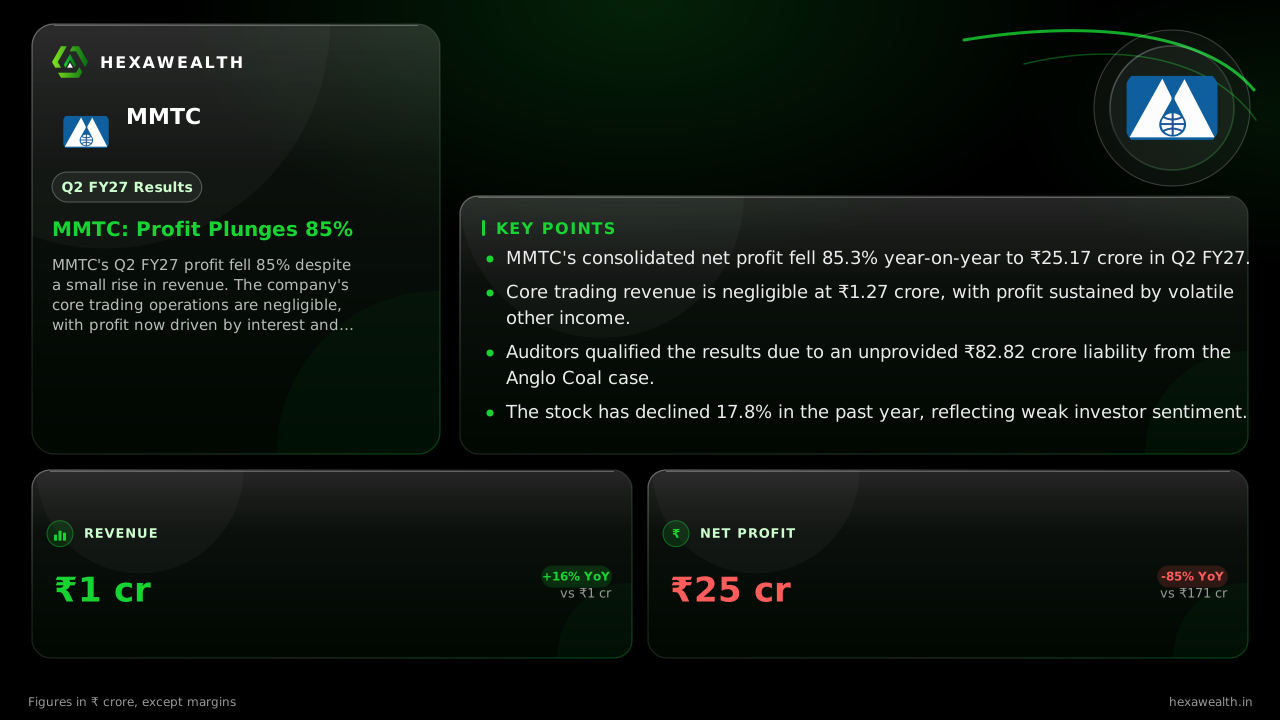
MMTC's Q2 FY27 profit fell 85% despite a small rise in revenue. The company's core trading operations are negligible, with profit now driven by interest and dividend income, while auditors flagged a significant liability.
MMTC, once India's giant state trader, is now a company living off its past. Its latest quarter shows a stark reality: a 15.5% rise in tiny operational revenue could not stop a 85.3% crash in consolidated net profit.
The numbers tell a story of a hollow core. Revenue from operations was just ₹1.27 crore. The reported profit of ₹25.17 crore came almost entirely from other sources, not from selling commodities.
Revenue & profit
Revenue (₹ Cr)
Profit (₹ Cr)
- Revenue (₹ Cr), Q2 FY26 (Sep 2025): 1.10
- Revenue (₹ Cr), Q3 FY26 (Dec 2025): 0.34
- Revenue (₹ Cr), Q4 FY26 (Mar 2026): 0.61
- Revenue (₹ Cr), Q1 FY27 (Jun 2026): 0.68
- Revenue (₹ Cr), Q2 FY27 (Sep 2026): 1.27
- Profit (₹ Cr), Q2 FY26 (Sep 2025): 170.81
- Profit (₹ Cr), Q3 FY26 (Dec 2025): 46.27
- Profit (₹ Cr), Q4 FY26 (Mar 2026): 126.04
- Profit (₹ Cr), Q1 FY27 (Jun 2026): 104.24
- Profit (₹ Cr), Q2 FY27 (Sep 2026): 25.17
Revenue (₹ Cr)
- Revenue (₹ Cr), Q2 FY26 (Sep 2025): 1.10
- Revenue (₹ Cr), Q3 FY26 (Dec 2025): 0.34
- Revenue (₹ Cr), Q4 FY26 (Mar 2026): 0.61
- Revenue (₹ Cr), Q1 FY27 (Jun 2026): 0.68
- Revenue (₹ Cr), Q2 FY27 (Sep 2026): 1.27
Profit (₹ Cr)
- Profit (₹ Cr), Q2 FY26 (Sep 2025): 170.81
- Profit (₹ Cr), Q3 FY26 (Dec 2025): 46.27
- Profit (₹ Cr), Q4 FY26 (Mar 2026): 126.04
- Profit (₹ Cr), Q1 FY27 (Jun 2026): 104.24
- Profit (₹ Cr), Q2 FY27 (Sep 2026): 25.17
| Metric | CurrentQ2 FY27 (Sep 2026) | PreviousQ1 FY27 (Jun 2026) |
|---|---|---|
| Revenue (₹ Cr) | 1.27 | 0.68 |
| Profit (₹ Cr) | 25.17 | 104.24 |
A business running on other income
Profitability is now driven by interest and dividends, not trading. According to reports from ScanX.Trade and FlashFinance, other income made up 96% of total standalone income this quarter. This stream is highly volatile, falling 74.8% from the previous quarter's windfall.
The core business itself is in retreat. Research from StockScans notes that MMTC operates under a government directive to exit non-strategic trades. Its former mainstays—iron ore, fertilizers, coal, and metals—now report zero revenue.
The Anglo Coal shadow and a quiet market
Adding uncertainty, statutory auditors issued a qualified conclusion on the results. They flagged that MMTC has not provided for an ₹82.82 crore liability related to the Anglo Coal litigation, as reported by ScanX.Trade.
Live Chart
· MMTC
(BSE)
ISIN: INE123F01029
The market has absorbed this story of fading operations. The stock closed at ₹53.99 ahead of the results, down 17.8% over the past year. Institutional interest remains minimal, with FII holding just 0.1%, per StockFin.ai analysis.
Key Points
- MMTC's consolidated net profit fell 85.3% year-on-year to ₹25.17 crore in Q2 FY27.
- Core trading revenue is negligible at ₹1.27 crore, with profit sustained by volatile other income.
- Auditors qualified the results due to an unprovided ₹82.82 crore liability from the Anglo Coal case.
- The stock has declined 17.8% in the past year, reflecting weak investor sentiment.
Hexa Perspective
MMTC's quarter confirms it is an asset-rich company in operational wind-down. The high return ratios like ROCE of 33.5% are historical artifacts, not indicators of current trading health. Future earnings will depend on the timing and size of dividend payouts from its joint ventures, like MMTC-PAMP, and the resolution of legal contingencies. The path forward is not about commodity cycles but about asset management and liability settlement. Investors are essentially betting on the value of the balance sheet, as the income statement offers no visibility on a trading revival.
Also read
Want this applied to your portfolio?
Talk to a HexaWealth advisor, or sync your mutual fund data for insights tailored to your holdings.