Maris Spinners (MARIS) Q2 FY27 Profit Dips as Cash Flow Lags a Strong Top Line
The cotton yarn maker's revenue grew 26% year-on-year, but profit slipped sequentially as rising costs and working capital demands squeezed cash generation.
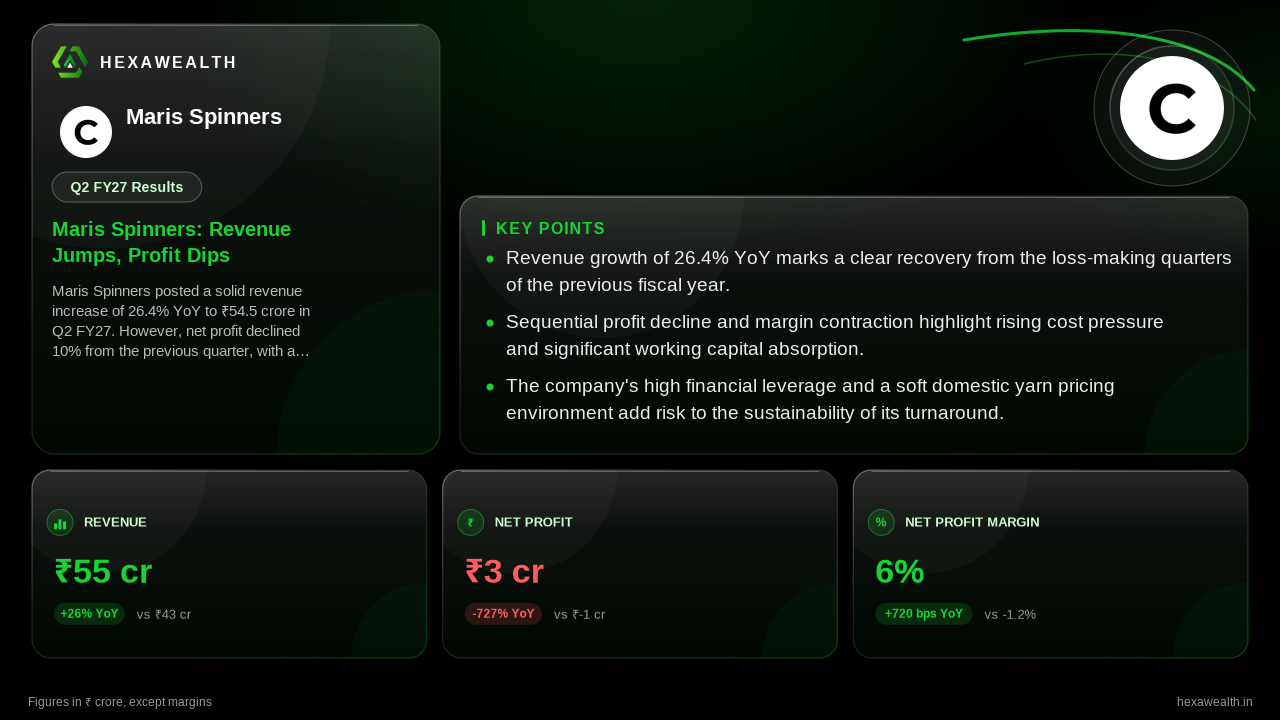
Maris Spinners posted a solid revenue increase of 26.4% YoY to ₹54.5 crore in Q2 FY27. However, net profit declined 10% from the previous quarter, with a significant portion of earnings absorbed by inventory buildup.
For a mid-sized cotton yarn spinner like Maris, the quarter was a story of two halves. Strong sales growth signaled a recovery from last year's losses, but the cash needed to fuel that growth did not fully materialize.
Revenue reached ₹54.5 crore, up 26.4% from a year ago and 13.5% from the prior quarter. Net profit was ₹3.26 crore, a sharp swing from a ₹0.52 crore loss in Q2 FY26. Yet profit slipped 10.2% from Q1, and the net profit margin contracted 160 basis points to 6%.
Revenue & profit
Revenue (₹ Cr)
Profit (₹ Cr)
Net Profit Margin (%)
| Metric | CurrentQ2 FY27 | PreviousQ1 FY27 | Same quarter LYQ2 FY26 |
|---|---|---|---|
| Revenue (₹ Cr) | 54.52YoY +26% | 48.05 | 43.12 |
| Profit (₹ Cr) | 3.26YoY +727% | 3.63 | -0.52 |
| Net Profit Margin (%) | 6.0YoY +600% | 7.6 | -1.2 |
Where the profit went
The margin squeeze came despite a reported decrease in the cost of materials consumed, according to a scanx.trade report. Total expenses, however, rose 14.4% quarter-on-quarter. More critically, a large part of the reported profit was absorbed by working capital. For the half-year, net cash from operations was just ₹3.63 crore, down sharply from ₹11.89 crore a year earlier.
Scanx.trade notes this was due to a ₹6.93 crore increase in inventories and a ₹5.02 crore reduction in trade payables. The company appears to be building stock, possibly in anticipation of demand, but it is tying up cash in the process.
A fragile recovery in a tough market
The broader market presents headwinds. A Commodity Board Europe analysis from early November describes a weak domestic cotton yarn environment, with weaving mills cutting purchases and prices softening despite tight raw cotton supply. This disconnect squeezes spinning margins.
Maris operates with a high debt load, a persistent challenge. Its debt-to-equity ratio stands at 3.61, and interest coverage is thin. Management has provided no formal guidance, focusing instead on operational discipline, according to a StockFin.ai analysis.
Key Points
- Revenue growth of 26.4% YoY marks a clear recovery from the loss-making quarters of the previous fiscal year.
- Sequential profit decline and margin contraction highlight rising cost pressure and significant working capital absorption.
- The company's high financial leverage and a soft domestic yarn pricing environment add risk to the sustainability of its turnaround.
Hexa Perspective
This quarter shows Maris Spinners is operationally recovering, but the quality of that recovery is mixed. The profit is not yet converting efficiently into cash, as evidenced by the large inventory buildup. For the turnaround to gain credibility, the next few quarters must demonstrate an ability to manage working capital more tightly and protect margins against volatile cotton prices and subdued downstream demand. The high debt burden means there is little room for error.
Also read
Want this applied to your portfolio?
Talk to a HexaWealth advisor, or sync your mutual fund data for insights tailored to your holdings.