Longspur (LONGSPUR) Q2 FY27's Revenue Jumps 742% as Trading Scale-Up Squeezes Margins
Longspur International Ventures reported a 742% surge in Q2 revenue, but profits grew just 39% as a major trading ramp-up drastically compressed margins.
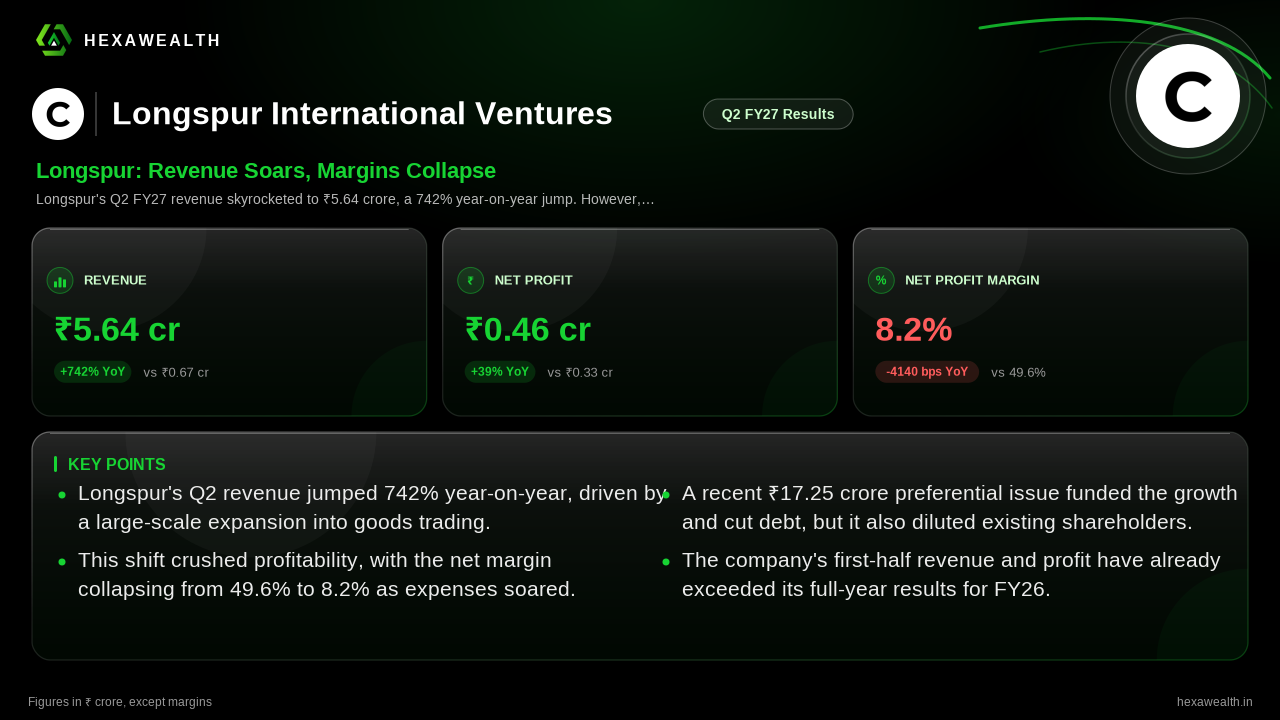
Longspur's Q2 FY27 revenue skyrocketed to ₹5.64 crore, a 742% year-on-year jump. However, net profit grew only 39% as a massive scale-up in goods trading slashed the net profit margin from 49.6% to 8.2%.
For Longspur International Ventures, a capital market and trading company, the September quarter was a story of scale over profitability. The company's revenue exploded, but the cost of that growth was a dramatic collapse in the bottom line.
The numbers tell a stark tale of expansion. Revenue surged to ₹5.64 crore, up 742% from a year ago and 652% from the previous quarter. Profit followed, rising 39% year-on-year to ₹0.46 crore.
Revenue & profit
Revenue (₹ Cr)
Profit (₹ Cr)
- Revenue (₹ Cr), Q2 FY26: 0.67
- Revenue (₹ Cr), Q3 FY26: 1.34
- Revenue (₹ Cr), Q4 FY26: 1.47
- Revenue (₹ Cr), Q1 FY27: 0.75
- Revenue (₹ Cr), Q2 FY27: 5.64
- Profit (₹ Cr), Q2 FY26: 0.33
- Profit (₹ Cr), Q3 FY26: 0.30
- Profit (₹ Cr), Q4 FY26: -0.29
- Profit (₹ Cr), Q1 FY27: 0.16
- Profit (₹ Cr), Q2 FY27: 0.46
Revenue (₹ Cr)
- Revenue (₹ Cr), Q2 FY26: 0.67
- Revenue (₹ Cr), Q3 FY26: 1.34
- Revenue (₹ Cr), Q4 FY26: 1.47
- Revenue (₹ Cr), Q1 FY27: 0.75
- Revenue (₹ Cr), Q2 FY27: 5.64
Profit (₹ Cr)
- Profit (₹ Cr), Q2 FY26: 0.33
- Profit (₹ Cr), Q3 FY26: 0.30
- Profit (₹ Cr), Q4 FY26: -0.29
- Profit (₹ Cr), Q1 FY27: 0.16
- Profit (₹ Cr), Q2 FY27: 0.46
Net Profit Margin
- Net Profit Margin, Q2 FY26: 49.6%
- Net Profit Margin, Q3 FY26: 22.6%
- Net Profit Margin, Q4 FY26: -19.9%
- Net Profit Margin, Q1 FY27: 20.9%
- Net Profit Margin, Q2 FY27: 8.2%
| Metric | CurrentQ2 FY27 | PreviousQ1 FY27 | Same quarter LYQ2 FY26 |
|---|---|---|---|
| Revenue (₹ Cr) | 5.64YoY +742% | 0.75 | 0.67 |
| Profit (₹ Cr) | 0.46YoY +39% | 0.16 | 0.33 |
| Net Profit Margin | 8.2%YoY -83% | 20.9% | 49.6% |
Why Margins Fell Off a Cliff
The explosive revenue came from a major ramp-up in trading goods, as noted by analysis from MCapital. This shift in business mix inherently carries lower margins. Total expenses ballooned by nearly 1,400% year-on-year, far outpacing sales growth.
The primary driver was a ₹4.60 crore line item for 'purchase of traded goods,' according to the company's financial statement cited by Cruxal. This cost of sales, absent a year ago, is the direct price of the revenue surge and explains the margin compression.
A Strengthened Balance Sheet
Financing this growth was a ₹17.25 crore preferential share issue completed earlier in the year. MCapital's analysis shows this capital raise was used to cut debt nearly in half and fund working capital for the trading expansion.
Live Chart
· LONGSPUR
(BSE)
ISIN: INE180M01033
This deleveraging strengthened the balance sheet, with net worth rising to about ₹48 crore. The trade-off, however, was significant share dilution, leaving earnings per share nearly flat year-on-year at ₹0.149.
The market's reaction has been muted. The stock fell 9.3% the day after the November results, according to MCapital. An analyst at MarketsMojo later upgraded the stock from 'Strong Sell' to 'Sell,' citing improved technicals but noting profitability challenges.
Key Points
- Longspur's Q2 revenue jumped 742% year-on-year, driven by a large-scale expansion into goods trading.
- This shift crushed profitability, with the net margin collapsing from 49.6% to 8.2% as expenses soared.
- A recent ₹17.25 crore preferential issue funded the growth and cut debt, but it also diluted existing shareholders.
- The company's first-half revenue and profit have already exceeded its full-year results for FY26.
Hexa Perspective
This quarter marks a strategic pivot for Longspur, trading its historically high-margin, low-volume model for a high-volume, low-margin one. The immediate financial effect is clear: top-line growth at the expense of bottom-line efficiency.
The sustainability of this new trajectory hinges on the company's ability to manage working capital and scale its trading operations profitably. Investors are now weighing a stronger, larger balance sheet against thinner margins and diluted ownership, a fundamental shift in the investment proposition.
Also read
Want this applied to your portfolio?
Talk to a HexaWealth advisor, or sync your mutual fund data for insights tailored to your holdings.