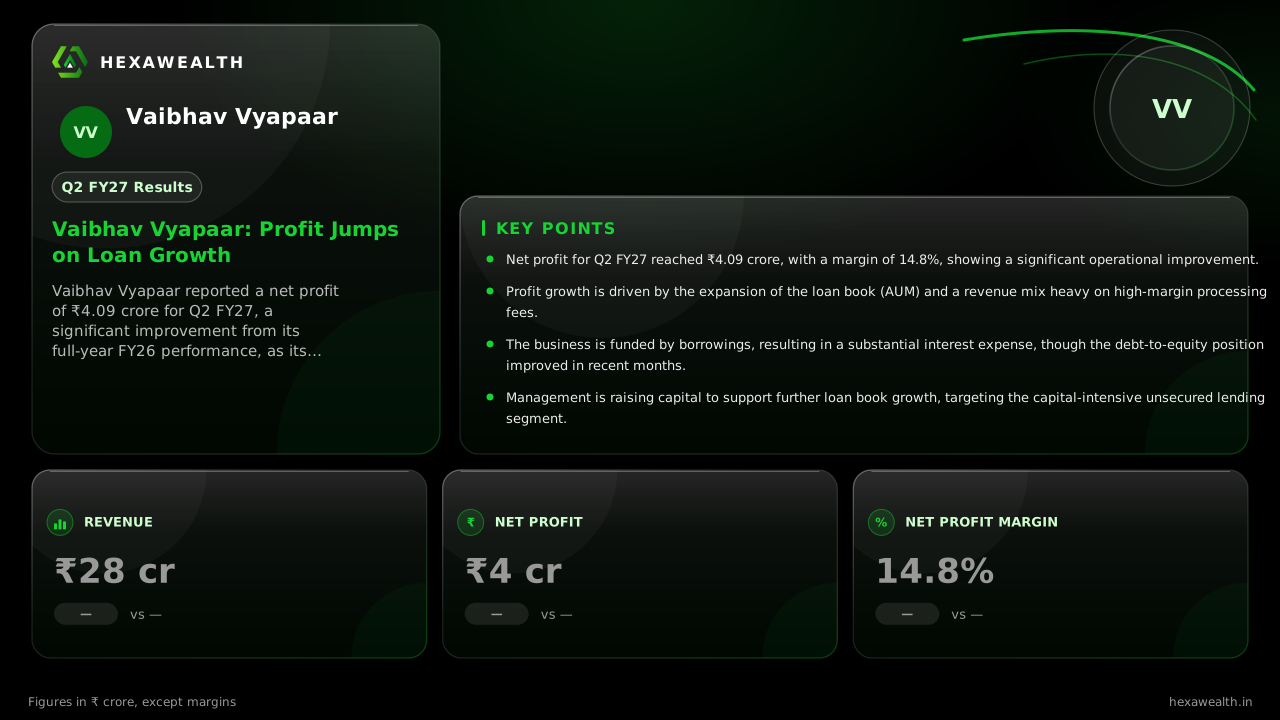
Vaibhav Vyapaar reported a net profit of ₹4.09 crore for Q2 FY27, a significant improvement from its full-year FY26 performance, as its assets under management continued to expand.
For a digital lender like Vaibhav Vyapaar, growth is measured by the expansion of its loan book. The September quarter shows that engine is running, delivering a sharp rise in profitability from a year ago.
The company posted a net profit of ₹4.09 crore on revenue of ₹27.59 crore. This translates to a net profit margin of 14.8%, a marked improvement from the 5.4% margin for the entire previous financial year.
Metric
CurrentQ2 FY27
Revenue (₹ Cr)
27.59
Profit (₹ Cr)
4.09
Net Profit Margin (%)
14.8
The Engine of Growth
The profit surge is rooted in the company's core lending activity. According to an IPO analysis by ipovista.com, Vaibhav Vyapaar's assets under management (AUM) have compounded hard, reaching ₹81.24 crore by July 2026. This expansion directly fuels interest income, which accounted for nearly 30% of revenue in FY26.
Processing fees from its LoanFront platform contributed an even larger 44% share. The company's model relies on repeat borrowers, which lowers customer acquisition costs and builds a proprietary repayment history for underwriting.
A Leveraged Balance Sheet
Funding this growth comes at a cost. The company reported an interest expense of ₹3.62 crore for the quarter. Research from FinMinutes shows finance costs have risen with higher borrowings, taken at rates between 16% and 19.75% to support lending expansion.
Live Chart
· LOANFRONT
(BSE)
ISIN: INE1KAA01025
The debt-to-equity ratio stood at 1.6 at the end of FY26, a level ipovista.com notes leaves limited headroom if demand softens. However, the ratio had improved to 0.8 by July 2026 following an increase in net worth.
Looking Ahead
Management is focused on capital to fuel the next leg of growth. A report from multibagg.ai states the company seeks to augment its capital base by ₹32 crore, despite already holding a Capital to Risk-weighted Assets Ratio (CRAR) of 43.80%, well above the regulatory minimum.
The funds are intended for onward lending, as the unsecured personal loan portfolio carries a 125% risk weight. This capital push, alongside the recent opening of a new business office in Bangalore, signals an intent to scale.
Key Points
Net profit for Q2 FY27 reached ₹4.09 crore, with a margin of 14.8%, showing a significant operational improvement.
Profit growth is driven by the expansion of the loan book (AUM) and a revenue mix heavy on high-margin processing fees.
The business is funded by borrowings, resulting in a substantial interest expense, though the debt-to-equity position improved in recent months.
Management is raising capital to support further loan book growth, targeting the capital-intensive unsecured lending segment.
“
Hexa Perspective
The quarter confirms the operating model can deliver profitability when the loan book scales. The jump in net profit margin from the full-year FY26 level is the clearest signal of that leverage.
The path forward, however, is paved with the same tightrope all digital lenders walk. Profitability depends on maintaining the delicate balance between growth, the cost of funds, and credit quality. The planned capital infusion aims to support the first, but the latter two will ultimately decide if this quarter's margin improvement is sustainable or a peak.
Talk to a HexaWealth advisor, or sync your mutual fund data for insights tailored to your holdings.
Frequently asked questions
What were Vaibhav Vyapaar's Q2 FY27 results?
For the quarter ended September 2026, Vaibhav Vyapaar reported revenue of ₹27.59 crore and a net profit of ₹4.09 crore. The company achieved a net profit margin of 14.8% for the quarter.
What drove Vaibhav Vyapaar's profit increase in Q2 FY27?
The profit increase was primarily driven by the expansion of the company's loan book, or Assets Under Management (AUM), which fuels interest income. High-margin processing fees from its LoanFront platform also contributed significantly to the improved profitability.
What was Vaibhav Vyapaar's net profit margin in Q2 FY27?
Vaibhav Vyapaar's net profit margin was 14.8% for the second quarter of FY27. This is a substantial improvement from the 5.4% margin reported for the full financial year ended March 2026.
Why is Vaibhav Vyapaar's interest expense significant?
Vaibhav Vyapaar reported an interest expense of ₹3.62 crore in Q2 FY27. This is a recurring cost of funding its loan book, with borrowings taken at rates between 16% and 19.75%, as noted in an analysis by FinMinutes.
What is Vaibhav Vyapaar's debt-to-equity ratio?
Vaibhav Vyapaar's debt-to-equity ratio was 1.6 at the end of FY26, as per its IPO analysis. This indicates a leveraged balance sheet, though the ratio improved to 0.8 by July 2026 following an increase in net worth.
What guidance did Vaibhav Vyapaar's management provide?
While specific quarterly guidance was not detailed in the research, management's focus is on growth. The company is seeking to raise ₹32 crore to augment its capital base for onward lending, as reported by multibagg.ai, aiming to expand its loan portfolio further.
Is Vaibhav Vyapaar undertaking any new projects?
Yes, the company is focused on expansion. It recently opened a new approximately 5,500 sq. ft. business office in Bangalore to support operations. Furthermore, it plans to deploy ₹32 crore from its IPO proceeds to augment its capital base for lending growth.
What is the outlook for Vaibhav Vyapaar's business sector?
The company operates in the digital unsecured lending space. The environment offers growth opportunities driven by financial inclusion but carries risks like regulatory changes, borrowing cost volatility, and the inherent credit risk of unsecured loans.
How did Vaibhav Vyapaar's stock price react to the Q2 results?
Specific post-announcement reaction data for November 14 is not in the provided research. However, in the days leading up to the results, the stock price was around ₹66.50, having traded between ₹66 and ₹68.70.
Have institutional investors changed their stake in Vaibhav Vyapaar?
Shareholding data shows a change following its public issue. As of October 2026, promoter holding was 72.34%, Foreign Institutional Investors (FIIs) held 0.82%, and Other Domestic Institutional Investors (DIIs) held 12.29%, according to Upstox.
Vaibhav Vyapaar Q2 FY27 results November 2026
Vaibhav Vyapaar announced its Q2 FY27 results for the period ended September 2026 on November 14, 2026. The company reported a quarterly net profit of ₹4.09 crore on revenue of ₹27.59 crore.
Vaibhav Vyapaar loan book growth Q2 FY27
Vaibhav Vyapaar's profit growth in Q2 FY27 was driven by the expansion of its loan book. The company's Assets Under Management (AUM) had reached ₹81.24 crore by July 2026, as noted in an IPO analysis, fueling its interest income.
Vaibhav Vyapaar interest expense Q2 FY27
In Q2 FY27, Vaibhav Vyapaar reported an interest expense of ₹3.62 crore. This is a structural cost from borrowings taken to fund its lending operations, with rates typically between 16% and 19.75% according to FinMinutes.
Vaibhav Vyapaar debt-to-equity ratio FY26
Vaibhav Vyapaar's debt-to-equity ratio was 1.6 times for the financial year ended March 2026 (FY26). This indicates a leveraged balance sheet, though the ratio improved to 0.8 times by July 2026.
Vaibhav Vyapaar CRAR July 2026
As of July 31, 2026, Vaibhav Vyapaar reported a Capital to Risk-weighted Assets Ratio (CRAR) of 43.80%. This is well above the regulatory minimum of 15%, providing a buffer for its unsecured lending activities.