Kesar Terminals (KTIL) Q2 FY27 Swings to Profit, But Port Litigation Clouds the Horizon
The bulk liquid storage firm posted a ₹2.6 crore net profit in Q2 FY27, a sharp reversal from last year's loss, but faces unresolved debt and a major legal dispute with its port landlord.
Kesar Terminals returned to profitability in the September quarter, driven by steady revenue growth and the absence of a large one-off loss. However, a weak balance sheet and unresolved litigation with Deendayal Port Trust pose significant risks to its recovery.
For Kesar Terminals, the story of Q2 FY27 is a tale of two realities. The headline shows a clear recovery, with the bulk storage operator swinging from a deep loss to a modest profit. Yet the underlying financial structure and a looming legal battle reveal a business still walking a tightrope.
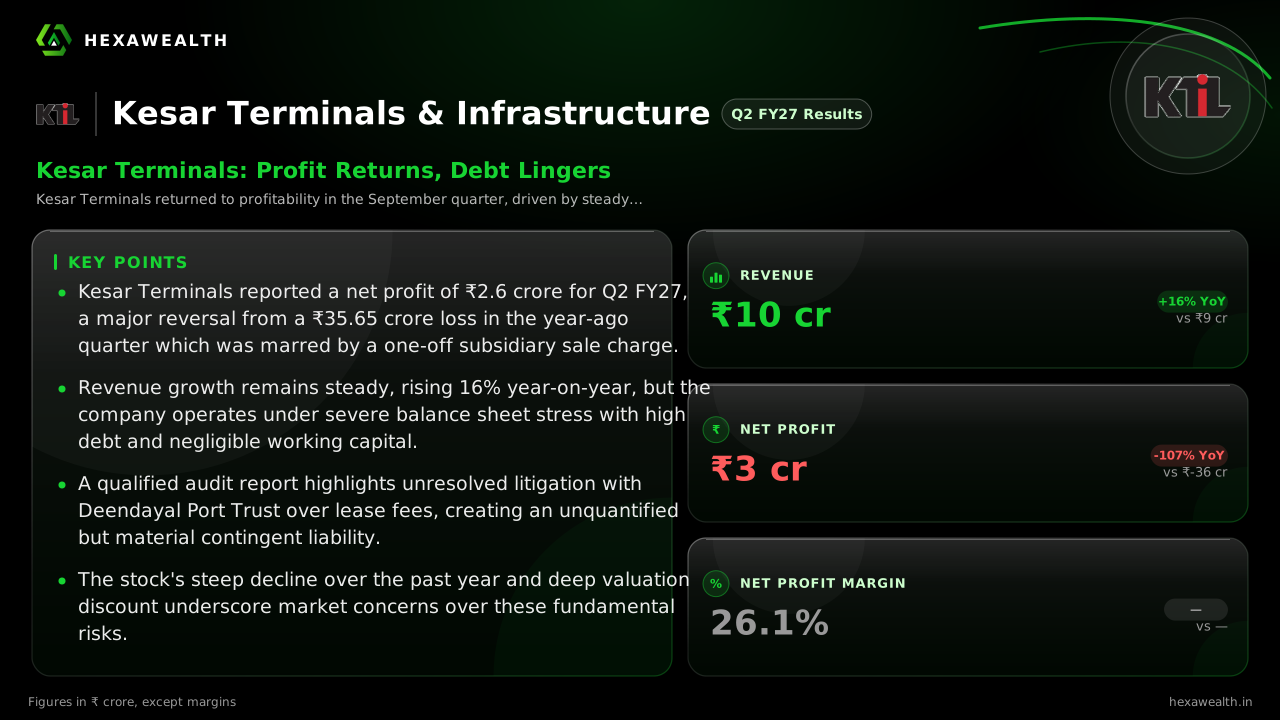
The numbers confirm the operational turnaround. Revenue grew 16% year-on-year to ₹9.95 crore, continuing a steady climb over recent quarters. Net profit landed at ₹2.6 crore, a stark contrast to the ₹35.65 crore loss in the same period last year.
Revenue & profit
Revenue (₹ Cr)
Profit (₹ Cr)
Net Profit Margin (%)
| Metric | CurrentQ2 FY27 (Sep 2026) | PreviousQ1 FY27 (Jun 2026) |
|---|---|---|
| Revenue (₹ Cr) | 9.95 | 9.55 |
| Profit (₹ Cr) | 2.6 | 2.35 |
| Net Profit Margin (%) | 26.1 | 24.6 |
Why the loss turned to profit
The dramatic year-on-year swing is largely technical. According to reports from MarketsMojo and ScanX, the Q2 FY26 loss included an exceptional charge of ₹36.5 crore from selling its subsidiary, Kesar Multimodal Logistics. With that one-off burden gone, the underlying business of storing chemicals and edible oils at Kandla Port is showing consistent, if modest, growth.
Profitability also improved sequentially, with the net margin rising 150 basis points to 26.1%. This was supported by a rise in other income, which surged nearly 288% year-on-year to ₹1.35 crore.
The anchor holding back the ship
Despite the profit, fundamental weaknesses persist. The company's debt-to-equity ratio stands at a high 1.29, and its interest cover is a thin 1.29 times. More alarming is an extremely low current ratio of 0.07, indicating severe working capital strain where current liabilities dwarf assets.
The biggest cloud is a legal dispute with its landlord, Deendayal Port Trust (DPT). Statutory auditors, cited in a Tulsian AI report, issued a qualified conclusion on the results, flagging this unresolved litigation. DPT is demanding transfer fees and higher lease rents, a liability for which no provision has been made.
The market has taken a dim view of these structural issues. The stock hit a 52-week low of ₹53.5 just before the results, as noted by MarketsMojo, and has fallen 36% over the past year. The valuation, at a P/E of 9.6, trades at a 77% discount to the industry average, reflecting deep skepticism.
Key Points
- Kesar Terminals reported a net profit of ₹2.6 crore for Q2 FY27, a major reversal from a ₹35.65 crore loss in the year-ago quarter which was marred by a one-off subsidiary sale charge.
- Revenue growth remains steady, rising 16% year-on-year, but the company operates under severe balance sheet stress with high debt and negligible working capital.
- A qualified audit report highlights unresolved litigation with Deendayal Port Trust over lease fees, creating an unquantified but material contingent liability.
- The stock's steep decline over the past year and deep valuation discount underscore market concerns over these fundamental risks.
Hexa Perspective
The quarter confirms Kesar Terminals' core storage operations are stable and cash-generative at current volumes. The removal of last year's exceptional loss cleans up the income statement, allowing a clearer view of this baseline performance.
Yet, the recovery is fragile. The balance sheet offers no cushion for shocks, and the port litigation represents a sword of Damocles. Until the DPT dispute is resolved or the capital structure is strengthened, the operational progress remains vulnerable to a single adverse ruling or a tightening in credit conditions. Investors are rightly pricing in this binary risk.
Also read
Want this applied to your portfolio?
Talk to a HexaWealth advisor, or sync your mutual fund data for insights tailored to your holdings.