Hipolin (HIPOLIN) Q2 FY27 Revenue Jumps 37% but Profit Remains a Sliver
The detergent maker's sales surged year-on-year, but rising input costs and a sequential slowdown kept net profit at just ₹1 lakh.
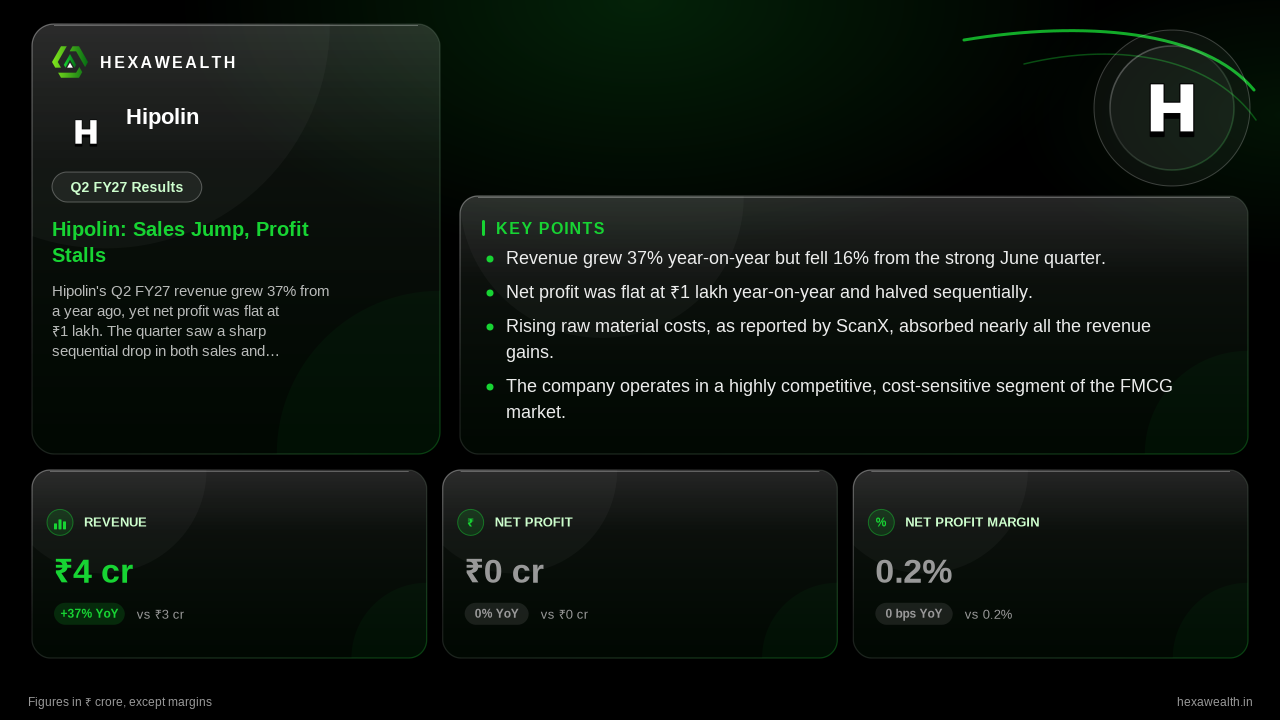
Hipolin's Q2 FY27 revenue grew 37% from a year ago, yet net profit was flat at ₹1 lakh. The quarter saw a sharp sequential drop in both sales and profit as costs rose faster than prices.
For a small detergent maker, the challenge is turning sales into sustainable profit. Hipolin's September quarter shows that tension clearly, with revenue jumping from a low base but profitability barely moving.
The company reported revenue of ₹4.37 crore, a 37% increase from the same quarter last year. Net profit, however, was just ₹1 lakh, unchanged year-on-year. Sequentially, both metrics fell sharply: revenue dropped 16% and profit halved from the June quarter.
Revenue & profit
Revenue (₹ Cr)
Profit (₹ Cr)
- Revenue (₹ Cr), Q2 FY26: 3.18
- Revenue (₹ Cr), Q3 FY26: 3.76
- Revenue (₹ Cr), Q4 FY26: 3.94
- Revenue (₹ Cr), Q1 FY27: 5.20
- Revenue (₹ Cr), Q2 FY27: 4.37
- Profit (₹ Cr), Q2 FY26: 0.01
- Profit (₹ Cr), Q3 FY26: 0.01
- Profit (₹ Cr), Q4 FY26: 0.01
- Profit (₹ Cr), Q1 FY27: 0.02
- Profit (₹ Cr), Q2 FY27: 0.01
Revenue (₹ Cr)
- Revenue (₹ Cr), Q2 FY26: 3.18
- Revenue (₹ Cr), Q3 FY26: 3.76
- Revenue (₹ Cr), Q4 FY26: 3.94
- Revenue (₹ Cr), Q1 FY27: 5.20
- Revenue (₹ Cr), Q2 FY27: 4.37
Profit (₹ Cr)
- Profit (₹ Cr), Q2 FY26: 0.01
- Profit (₹ Cr), Q3 FY26: 0.01
- Profit (₹ Cr), Q4 FY26: 0.01
- Profit (₹ Cr), Q1 FY27: 0.02
- Profit (₹ Cr), Q2 FY27: 0.01
Net Profit Margin (%)
- Net Profit Margin (%), Q2 FY26: 0.2
- Net Profit Margin (%), Q3 FY26: 0.2
- Net Profit Margin (%), Q4 FY26: 0.1
- Net Profit Margin (%), Q1 FY27: 0.4
- Net Profit Margin (%), Q2 FY27: 0.2
| Metric | CurrentQ2 FY27 | PreviousQ1 FY27 | Same quarter LYQ2 FY26 |
|---|---|---|---|
| Revenue (₹ Cr) | 4.37YoY +37% | 5.20 | 3.18 |
| Profit (₹ Cr) | 0.01YoY 0% | 0.02 | 0.01 |
| Net Profit Margin (%) | 0.2YoY 0% | 0.4 | 0.2 |
Why the growth didn't reach the bottom line
The revenue surge was driven by higher sales volumes in its detergent segment, according to a report from ScanX. Yet the cost of materials consumed rose sharply to ₹2.90 crore from ₹2.05 crore a year ago, as noted in the same analysis. This kept margins thin, with total expenses rising nearly in lockstep with revenue.
A tough market backdrop
The broader FMCG sector is grappling with rising input costs, from surfactants to packaging. A report in The Core notes companies are shrinking pack sizes and considering post-Diwali price hikes to cope. For a small player like Hipolin, passing on costs without losing volume is an even steeper challenge.
Its financial position remains tight. The trailing-twelve-month net profit margin is just 0.2%, and the stock trades at a significant premium to the industry P/E, reflecting its micro-cap status more than earnings power.
Live Chart
· HIPOLIN
(BSE)
ISIN: INE963A01011
Key Points
- Revenue grew 37% year-on-year but fell 16% from the strong June quarter.
- Net profit was flat at ₹1 lakh year-on-year and halved sequentially.
- Rising raw material costs, as reported by ScanX, absorbed nearly all the revenue gains.
- The company operates in a highly competitive, cost-sensitive segment of the FMCG market.
Hexa Perspective
Hipolin's quarter illustrates the classic squeeze for a small-scale FMCG player. Volume-led top-line growth is positive, but it offers no pricing power to protect margins from input cost inflation.
The path to sustained profitability requires either a structural reduction in costs or a successful shift to more premium products. With the industry facing persistent cost pressures, the near-term outlook remains one of fragile margins, where revenue growth alone does not guarantee earnings improvement.
Also read
Want this applied to your portfolio?
Talk to a HexaWealth advisor, or sync your mutual fund data for insights tailored to your holdings.