Humming Bird Education (HBEL) Q2 FY27 Profit Drops 32% as Revenue Declines
The education firm's quarterly profit fell 31.9% year-on-year to ₹0.64 crore, with revenue down 12.3% to ₹4.62 crore.
Humming Bird Education's Q2 FY27 results show a 31.9% drop in net profit and a 12.3% fall in revenue from a year ago. A sharp decline in other income and higher tax expenses weighed on the bottom line.
Humming Bird Education navigated a seasonally weak quarter for its Olympiad and assessment business, but the year-on-year comparison proved challenging. Revenue fell 12.3% from a strong prior-year period, and profit dropped even faster as one-time income dried up.
The September quarter brought a net profit of ₹0.64 crore, down 31.9% from last year. Revenue stood at ₹4.62 crore. The net profit margin contracted by 390 basis points to 13.9%.
Revenue & profit
Revenue (₹ Cr)
Profit (₹ Cr)
- Revenue (₹ Cr), Q2 FY25: 5.00
- Revenue (₹ Cr), Q4 FY25: 1.28
- Revenue (₹ Cr), Q2 FY26: 5.27
- Revenue (₹ Cr), Q4 FY26: 2.67
- Revenue (₹ Cr), Q2 FY27: 4.62
- Profit (₹ Cr), Q2 FY25: 1.05
- Profit (₹ Cr), Q4 FY25: -0.33
- Profit (₹ Cr), Q2 FY26: 0.94
- Profit (₹ Cr), Q4 FY26: -0.12
- Profit (₹ Cr), Q2 FY27: 0.64
Revenue (₹ Cr)
- Revenue (₹ Cr), Q2 FY25: 5.00
- Revenue (₹ Cr), Q4 FY25: 1.28
- Revenue (₹ Cr), Q2 FY26: 5.27
- Revenue (₹ Cr), Q4 FY26: 2.67
- Revenue (₹ Cr), Q2 FY27: 4.62
Profit (₹ Cr)
- Profit (₹ Cr), Q2 FY25: 1.05
- Profit (₹ Cr), Q4 FY25: -0.33
- Profit (₹ Cr), Q2 FY26: 0.94
- Profit (₹ Cr), Q4 FY26: -0.12
- Profit (₹ Cr), Q2 FY27: 0.64
Net Profit Margin (%)
- Net Profit Margin (%), Q2 FY25: 21.0
- Net Profit Margin (%), Q4 FY25: -25.8
- Net Profit Margin (%), Q2 FY26: 17.8
- Net Profit Margin (%), Q4 FY26: -4.5
- Net Profit Margin (%), Q2 FY27: 13.9
| Metric | CurrentQ2 FY27 | Same quarter LYQ2 FY26 |
|---|---|---|
| Period Ended | Sep 2026 | Sep 2025 |
| Revenue (₹ Cr) | 4.62YoY -12% | 5.27 |
| Profit (₹ Cr) | 0.64YoY -32% | 0.94 |
| Net Profit Margin (%) | 13.9YoY -22% | 17.8 |
Why the Bottom Line Shrank
The profit decline was sharper than the revenue drop for two clear reasons. First, other income plummeted 80.5% year-on-year to just ₹0.08 crore, according to the analysis. Second, a higher tax expense compressed the final profit, as noted in a report from scanx.trade.
A Stronger Base From Last Year
The revenue decline is partly a function of a tough comparison. The Q2 FY26 quarter saw revenue of ₹5.27 crore, which was a high point in the company's recent history. The current quarter's performance, while lower, still represents a significant 73% sequential recovery from the loss-making March quarter.
The Path Forward
Management's focus remains on reinvestment for growth. The annual report highlighted strategic priorities to expand Olympiads and deepen digital learning, as summarized by StockFin.ai. The board has proposed no dividend to retain earnings for this expansion.
Live Chart
· HBEL
(BSE)
ISIN: INE02PC01027
Key Points
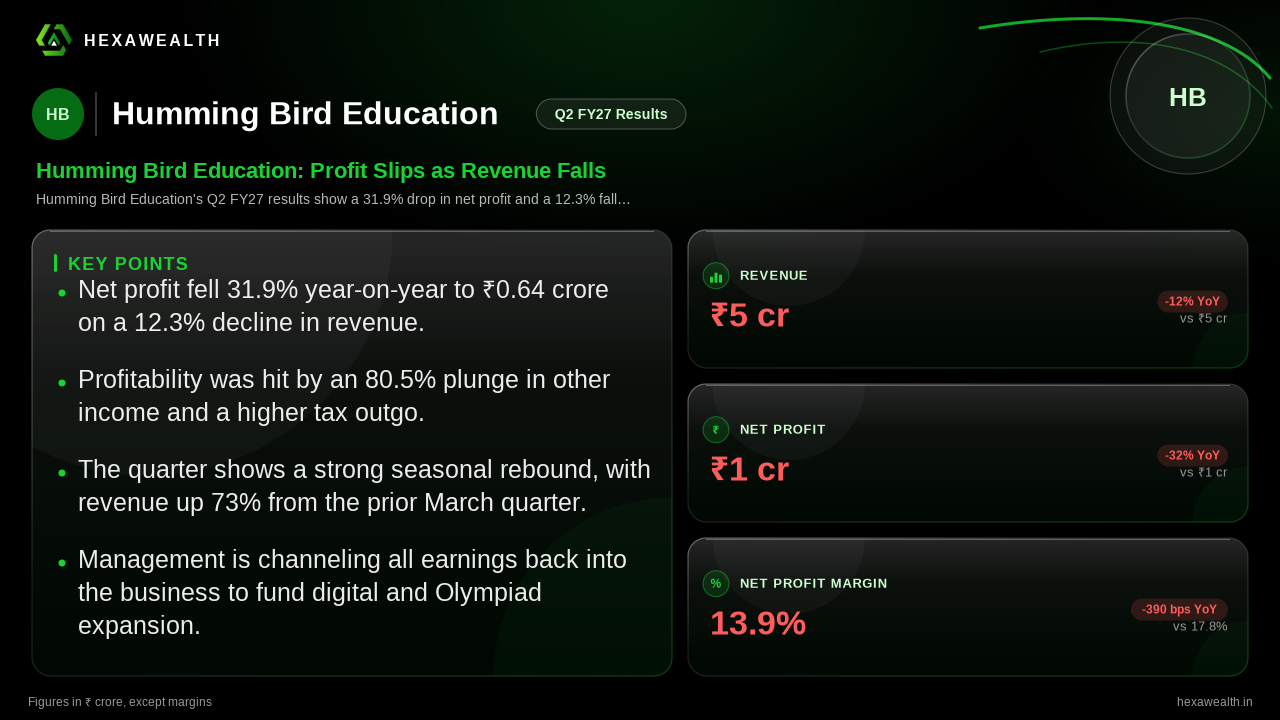
- Net profit fell 31.9% year-on-year to ₹0.64 crore on a 12.3% decline in revenue.
- Profitability was hit by an 80.5% plunge in other income and a higher tax outgo.
- The quarter shows a strong seasonal rebound, with revenue up 73% from the prior March quarter.
- Management is channeling all earnings back into the business to fund digital and Olympiad expansion.
Hexa Perspective
The quarter underscores the inherent seasonality of an event-driven education business. The year-on-year profit squeeze, driven by the absence of prior-year other income, is a one-off adjustment rather than a new operational norm.
Investors are left weighing a clean, debt-free balance sheet and a clear reinvestment strategy against a valuation that trades at a steep 80% discount to the industry average PE. The next few quarters will test if the retained capital can drive consistent top-line growth beyond these seasonal swings.
Also read
Want this applied to your portfolio?
Talk to a HexaWealth advisor, or sync your mutual fund data for insights tailored to your holdings.