All posts

Follow Us

LinkedInInstagramX
Quarterly ResultsArchiveLast updated 11 November 20263 min read

Glottis (GLOTTIS) Profit Evaporates Despite 18% Revenue Jump in Q2 FY27

The logistics firm's sales rose to ₹276 crore, but a sharp rise in costs pushed net profit to near zero, erasing a 4.6% margin from the prior quarter.

By Abhinav Singhvi, Founder & CEO Hexawealth · Created 11 November 2026

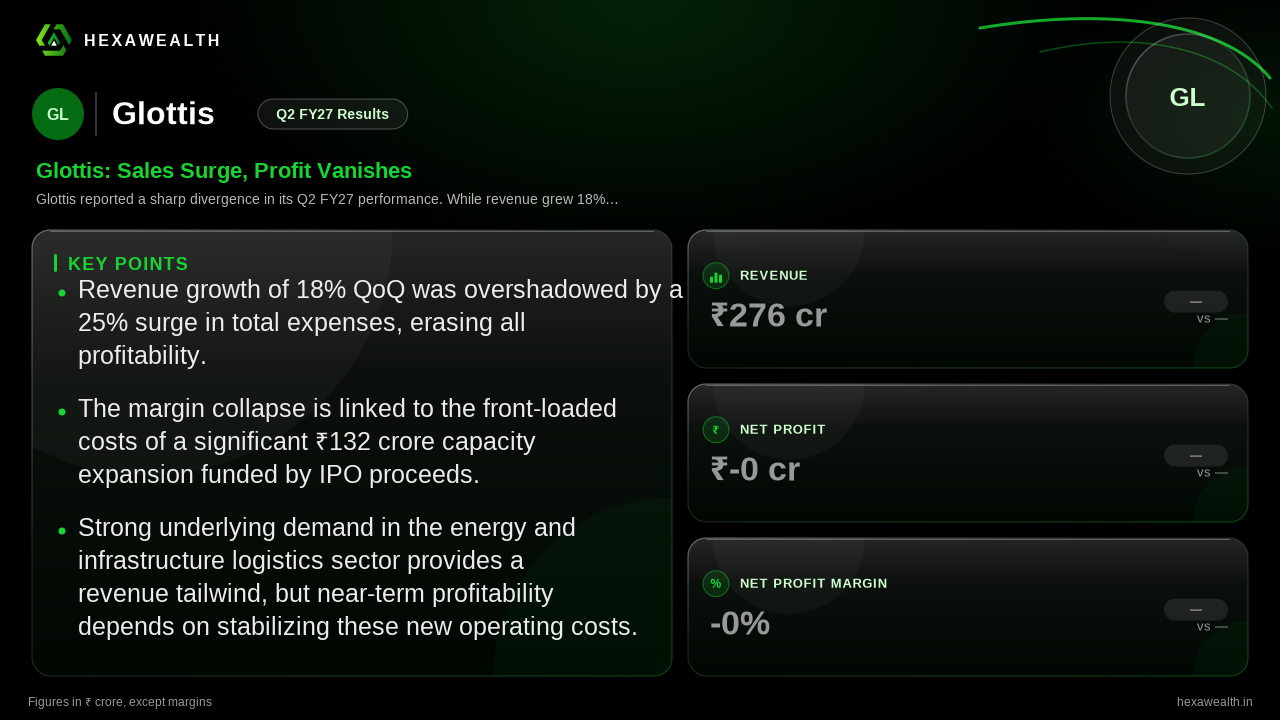
Glottis reported a sharp divergence in its Q2 FY27 performance. While revenue grew 18% sequentially to ₹276 crore, net profit collapsed to a negligible loss, as total expenses surged 25% and wiped out margins.

For Glottis, a recently listed logistics player, the September quarter was a story of growth that never reached the bottom line. The company delivered a strong 18% sequential rise in revenue, but a sharper surge in costs completely erased its profitability, turning a ₹10.7 crore profit into a near-zero result.

The numbers show a stark disconnect. Revenue climbed to ₹276.5 crore from ₹234.5 crore the previous quarter. Yet, net profit collapsed to a negligible loss of ₹0.02 crore. This wiped out the 4.6% net profit margin Glottis held in Q1, pushing it to effectively zero.

Revenue & profit

Revenue (₹ Cr)

Profit (₹ Cr)

Revenue & profitQ4 FY26 (Mar '26) 195.85, Q1 FY27 (Jun '26) 234.51, Q2 FY27 (Sep '26) 276.48. Q4 FY26 (Mar '26) 10.67, Q1 FY27 (Jun '26) 10.68, Q2 FY27 (Sep '26) -0.02-400-2000200400Q4 FY26 (Mar '26)Q1 FY27 (Jun '26)Q2 FY27 (Sep '26)
  • Revenue (₹ Cr), Q4 FY26 (Mar '26): 195.85
  • Revenue (₹ Cr), Q1 FY27 (Jun '26): 234.51
  • Revenue (₹ Cr), Q2 FY27 (Sep '26): 276.48
  • Profit (₹ Cr), Q4 FY26 (Mar '26): 10.67
  • Profit (₹ Cr), Q1 FY27 (Jun '26): 10.68
  • Profit (₹ Cr), Q2 FY27 (Sep '26): -0.02

Revenue (₹ Cr)

Revenue (₹ Cr)Q4 FY26 (Mar '26) 195.85, Q1 FY27 (Jun '26) 234.51, Q2 FY27 (Sep '26) 276.480100200300400Q4 FY26 (Mar '26)Q1 FY27 (Jun '26)Q2 FY27 (Sep '26)
  • Revenue (₹ Cr), Q4 FY26 (Mar '26): 195.85
  • Revenue (₹ Cr), Q1 FY27 (Jun '26): 234.51
  • Revenue (₹ Cr), Q2 FY27 (Sep '26): 276.48

Profit (₹ Cr)

Profit (₹ Cr)Q4 FY26 (Mar '26) 10.67, Q1 FY27 (Jun '26) 10.68, Q2 FY27 (Sep '26) -0.02-20-1001020Q4 FY26 (Mar '26)Q1 FY27 (Jun '26)Q2 FY27 (Sep '26)
  • Profit (₹ Cr), Q4 FY26 (Mar '26): 10.67
  • Profit (₹ Cr), Q1 FY27 (Jun '26): 10.68
  • Profit (₹ Cr), Q2 FY27 (Sep '26): -0.02

Net Profit Margin (%)

Net Profit Margin (%)Q4 FY26 (Mar '26) 5.4, Q1 FY27 (Jun '26) 4.6, Q2 FY27 (Sep '26) -0.00%2%4%6%8%Q4 '26Q1 '27Q2 '27
  • Net Profit Margin (%), Q4 FY26 (Mar '26): 5.4
  • Net Profit Margin (%), Q1 FY27 (Jun '26): 4.6
  • Net Profit Margin (%), Q2 FY27 (Sep '26): -0.0
MetricCurrentQ2 FY27 (Sep '26)PreviousQ1 FY27 (Jun '26)
Revenue (₹ Cr)
276.48
234.51
Profit (₹ Cr)
-0.02
10.68
Net Profit Margin (%)
-0.0
4.6

Why the top-line win turned into a loss

Total expenses jumped 25% quarter-on-quarter, far outpacing revenue growth. This was driven by a broad-based increase across key cost heads. Employee costs rose 15%, interest expense surged 35%, and depreciation climbed 23%, according to the company's filings.

The rise in depreciation and interest points directly to the company's ongoing expansion. Management, as noted by StockFin.ai, is executing a ₹132 crore IPO-funded capex program for trailers and containers. The opening of a new branch in Hyderabad, announced in early November, also adds to these fixed costs before new revenue fully materializes.

The market's wait-and-see stance

With no published analyst estimates for this newly listed stock, the market reaction has been shaped by the broader trend. The stock has declined about 19% over the past year, reflecting investor caution. Institutional holdings remain minimal, with FII stake dipping slightly to 0.67% in September, per Cruxal data.

Live Chart

· GLOTTIS

(BSE)

ISIN: INE0TQE01026

The core demand environment remains supportive, especially in Glottis's key renewable energy sector. Reports like one from Policy Circle highlight a power crunch in India creating urgent fuel logistics problems, which should sustain demand for specialized transport services.

Key Points

  • Revenue growth of 18% QoQ was overshadowed by a 25% surge in total expenses, erasing all profitability.
  • The margin collapse is linked to the front-loaded costs of a significant ₹132 crore capacity expansion funded by IPO proceeds.
  • Strong underlying demand in the energy and infrastructure logistics sector provides a revenue tailwind, but near-term profitability depends on stabilizing these new operating costs.

Hexa Perspective

The quarter reveals the classic tension of a capex-heavy growth phase. Glottis is investing for scale, but the benefits of owned containers and a broader network are yet to flow through. The next few quarters will test whether revenue can continue its climb and absorb these higher fixed costs to restore margins.

The company's valuation, at a P/E of 9.4 against an industry average of 42.7, already prices in significant uncertainty. Investors are effectively betting that the current margin pain is a temporary investment, not a permanent feature of the business model. The conference call on November 12 will be critical for management to outline the timeline for this transition.

Share or follow HexaWealth

Also read

Want this applied to your portfolio?

Talk to a HexaWealth advisor, or sync your mutual fund data for insights tailored to your holdings.
Glottis (GLOTTIS) Q2 FY27 results, revenue and profits.

Frequently asked questions

What were Glottis's Q2 FY27 results?
Glottis reported revenue of ₹276.48 crore for the September 2026 quarter, an 18% increase from the previous quarter. However, net profit collapsed to a loss of ₹0.02 crore, compared to a profit of ₹10.68 crore in Q1 FY27, as total expenses surged 25%.
Why did Glottis's profit turn negative in Q2 FY27 despite revenue growth?
Glottis's profit turned negative because total expenses rose 25% quarter-on-quarter, far outpacing the 18% revenue growth. This surge was driven by higher employee costs, a 35% jump in interest expense, and a 23% rise in depreciation linked to the company's ongoing capacity expansion.
What caused the 25% quarter-on-quarter surge in total expenses for Glottis?
The 25% QoQ surge in Glottis's total expenses was broad-based. Key drivers included a 15% rise in employee costs, a 35% increase in interest expense, and a 23% jump in depreciation. These increases are tied to the company's active capital expenditure program for fleet and network expansion.
Did Glottis face a sharp increase in interest costs in Q2 FY27?
Yes, Glottis's interest expense rose sharply by 35% quarter-on-quarter to ₹2.12 crore in Q2 FY27, up from ₹1.57 crore in the June quarter. This increase is consistent with the company utilizing debt to fund its ongoing expansion plans.
What led to the 23% increase in depreciation for Glottis in the September quarter?
The 23% QoQ increase in depreciation to ₹2.78 crore is directly linked to Glottis's capital expenditure. The company is deploying IPO funds for a ₹132 crore expansion, adding owned vehicles and containers, which increases the asset base and the associated depreciation charge.
What is the status of Glottis's working capital and cash flow?
For the full year FY26, Glottis reported an operating cash flow of -₹68.79 crore, as per informed.sh data. This negative outflow highlights the working capital intensity of the logistics business, especially during a phase of rapid growth and expansion.
Is Glottis undergoing significant capacity expansion?
Yes, Glottis is in a significant expansion phase. Management, cited by StockFin.ai, is executing a ₹132 crore IPO-funded capex program for trailers and containers to be completed by March 2027. The company also recently opened a new branch in Hyderabad to expand its operational reach.
What guidance did Glottis management provide for FY27?
Based on prior commentary, Glottis management has stated it expects FY27 revenue to exceed FY25 levels. The company will host a conference call on November 12 to discuss the Q2 and H1 FY27 results, where updated commentary on profitability and outlook may be provided.
Did Glottis Q2 FY27 results beat or miss analyst estimates?
Glottis, as a recently listed company, does not have widely published analyst consensus estimates for quarterly results, as noted by Sharpely.in. Therefore, the results are primarily judged on a sequential trend basis rather than against external forecasts.
Which brokerages have changed their rating for Glottis after the Q2 results?
There is no information in the research about brokerages changing ratings or target prices specifically after the Q2 FY27 results. The company's limited coverage and recent listing status mean such actions are less common.
Are mutual funds or FIIs increasing their stake in Glottis?
No, institutional stakes are minimal and declining slightly. As of September 2026, FII holding was 0.67%, down from 0.85% in June, and DII holding was steady at 0.84%, according to Cruxal data. Promoters hold a steady 74.23%.
How did Glottis's stock price react to the Q2 FY27 results?
The specific intraday reaction on the results date (November 14) is not provided in the research snippets. However, the stock has declined approximately 19% over the past year, reflecting broader market sentiment and the challenges highlighted in the quarterly performance.
What was Glottis management's outlook during the Q1 FY27 results?
During the Q1 FY27 results in August, management highlighted a focus on customer additions, cost discipline, and improving operating efficiency. They also reiterated expectations for FY27 revenue to exceed FY25 levels, driven by strategic diversification.
Were there any one-time gains that boosted Glottis's profit in Q1 FY27?
No, there is no indication of one-time gains boosting profit in Q1 FY27. The company's profit of ₹10.68 crore was derived from operating performance, with no exceptional items reported in the financials for that quarter.
Glottis Q2 profit drop
Glottis's Q2 FY27 net profit dropped over 100% sequentially to a loss of ₹0.02 crore, from a profit of ₹10.68 crore in Q1. The drop was caused by a 25% surge in total expenses, including higher interest and depreciation costs from the company's expansion plans.