GIC Housing Finance (GICHSGFIN) Q2 FY27 Profit Jumps 14% as Provision Write-Back Lifts Margins
A sharp reversal in credit impairment charges drove a 468% sequential profit jump, though loan growth remains muted amid a competitive housing finance market.
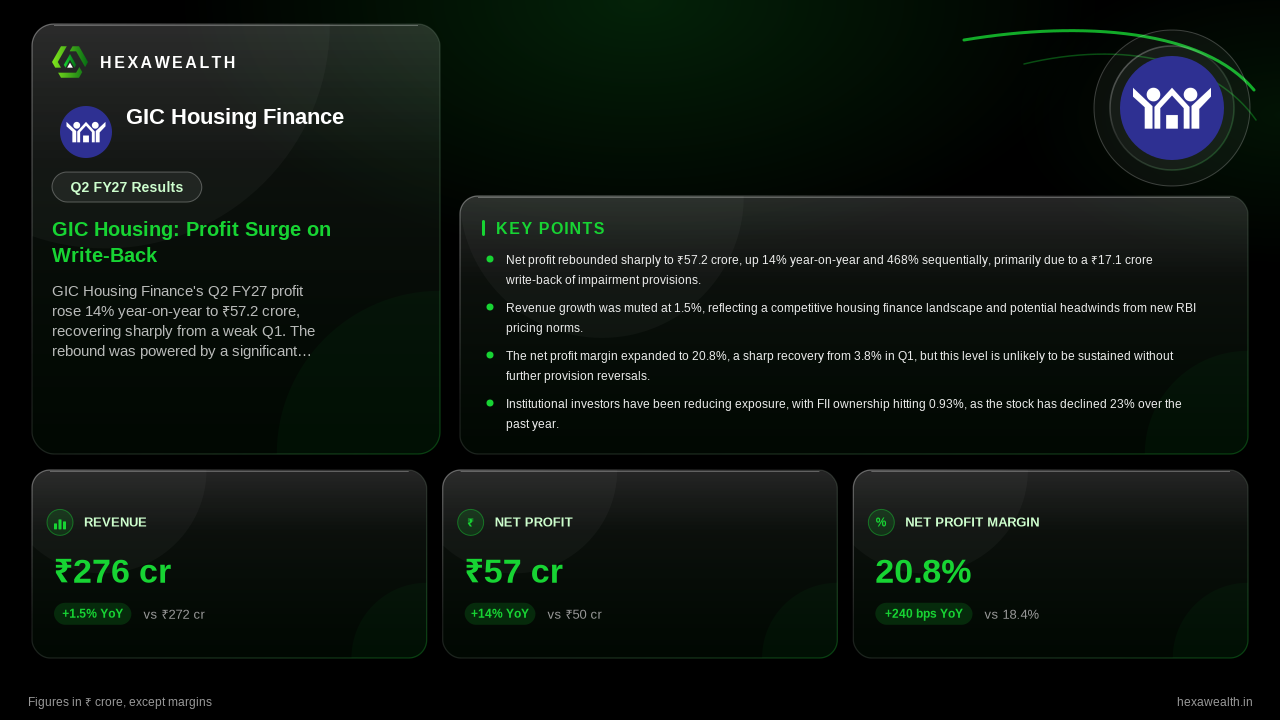
GIC Housing Finance's Q2 FY27 profit rose 14% year-on-year to ₹57.2 crore, recovering sharply from a weak Q1. The rebound was powered by a significant write-back of impairment provisions, lifting the net profit margin to 20.8%.
For a housing finance company, quarterly profit often hinges on the delicate balance between loan growth and credit costs. GIC Housing Finance's September quarter saw the scales tip decisively on the latter, with a sharp reversal in provisioning driving a massive profit rebound from a weak June quarter.
Revenue grew a modest 1.5% year-on-year to ₹275.5 crore, while net profit jumped 14.4% to ₹57.2 crore. The real story is the sequential leap: profit surged 468% from ₹10.1 crore in Q1, pushing the net profit margin to 20.8% from just 3.8%.
Revenue & profit
Revenue (₹ Cr)
Profit (₹ Cr)
- Revenue (₹ Cr), Q2 FY26 (Sep 2025): 271.54
- Revenue (₹ Cr), Q3 FY26 (Dec 2025): 272.63
- Revenue (₹ Cr), Q4 FY26 (Mar 2026): 272.70
- Revenue (₹ Cr), Q1 FY27 (Jun 2026): 266.76
- Revenue (₹ Cr), Q2 FY27 (Sep 2026): 275.53
- Profit (₹ Cr), Q2 FY26 (Sep 2025): 50.03
- Profit (₹ Cr), Q3 FY26 (Dec 2025): 43.69
- Profit (₹ Cr), Q4 FY26 (Mar 2026): 53.68
- Profit (₹ Cr), Q1 FY27 (Jun 2026): 10.08
- Profit (₹ Cr), Q2 FY27 (Sep 2026): 57.24
Revenue (₹ Cr)
- Revenue (₹ Cr), Q2 FY26 (Sep 2025): 271.54
- Revenue (₹ Cr), Q3 FY26 (Dec 2025): 272.63
- Revenue (₹ Cr), Q4 FY26 (Mar 2026): 272.70
- Revenue (₹ Cr), Q1 FY27 (Jun 2026): 266.76
- Revenue (₹ Cr), Q2 FY27 (Sep 2026): 275.53
Profit (₹ Cr)
- Profit (₹ Cr), Q2 FY26 (Sep 2025): 50.03
- Profit (₹ Cr), Q3 FY26 (Dec 2025): 43.69
- Profit (₹ Cr), Q4 FY26 (Mar 2026): 53.68
- Profit (₹ Cr), Q1 FY27 (Jun 2026): 10.08
- Profit (₹ Cr), Q2 FY27 (Sep 2026): 57.24
Net Profit Margin (%)
- Net Profit Margin (%), Q2 FY26 (Sep 2025): 18.4
- Net Profit Margin (%), Q3 FY26 (Dec 2025): 16.0
- Net Profit Margin (%), Q4 FY26 (Mar 2026): 19.7
- Net Profit Margin (%), Q1 FY27 (Jun 2026): 3.8
- Net Profit Margin (%), Q2 FY27 (Sep 2026): 20.8
| Metric | CurrentQ2 FY27 (Sep 2026) | PreviousQ1 FY27 (Jun 2026) |
|---|---|---|
| Revenue (₹ Cr) | 275.53 | 266.76 |
| Profit (₹ Cr) | 57.24 | 10.08 |
| Net Profit Margin (%) | 20.8 | 3.8 |
The provision reversal that powered profit
The dramatic margin expansion stemmed from a significant swing in credit costs. According to a report from FlashFinance, net impairment losses shifted to a write-back of ₹17.1 crore in Q2, compared to a charge of ₹32.5 crore in Q1. This ₹49.6 crore positive swing in impairment charges was the primary driver of the sequential profit surge, more than offsetting a slight rise in interest and employee costs.
A steady top line in a tough market
While the bottom line recovered, the top-line growth remained tepid. The 1.5% annual revenue increase reflects a challenging competitive environment. Reports from Kotak Institutional Equities, cited by Moneycontrol, suggest new RBI draft norms could limit pricing flexibility for prime housing finance companies. This backdrop makes substantial loan book expansion difficult without sacrificing margins.
The company's asset quality remains a focus. Data from Nivata Wealth shows the Gross Stage 3 (NPA) ratio was 4.49% as of June 2026, up from 3.96% in March. The provision coverage ratio stood at 55.7%. The Q2 write-back suggests some improvement, but sustained asset quality is key for stable earnings.
Live Chart
· GICHSGFIN
(BSE)
ISIN: INE289B01019
The market's cautious read
The stock closed at ₹131.11 on November 11, the day before the board meeting, down nearly 23% over the past year. Institutional sentiment has been weak, with FII ownership falling for five consecutive quarters to 0.93% by September 2026, as per data from SectorAlpha. The market appears to be discounting the one-off nature of the provision benefit and focusing on the underlying challenges of growth and competition.
Key Points
- Net profit rebounded sharply to ₹57.2 crore, up 14% year-on-year and 468% sequentially, primarily due to a ₹17.1 crore write-back of impairment provisions.
- Revenue growth was muted at 1.5%, reflecting a competitive housing finance landscape and potential headwinds from new RBI pricing norms.
- The net profit margin expanded to 20.8%, a sharp recovery from 3.8% in Q1, but this level is unlikely to be sustained without further provision reversals.
- Institutional investors have been reducing exposure, with FII ownership hitting 0.93%, as the stock has declined 23% over the past year.
Hexa Perspective
This quarter's profit surge is a balance-sheet clean-up story, not an operational breakout. The core challenge of generating loan growth in a crowded market, while managing asset quality, remains unchanged. The provision write-back provides a one-time earnings boost and capital relief, but it does not alter the fundamental growth trajectory. Investors are rightly weighing the transient margin lift against the stock's depressed valuation—trading at a P/E of 4.6, a 74% discount to the industry. For the stock to re-rate, the company needs to demonstrate that it can grow its loan book consistently without a relapse in credit costs, a tall order in the current rate environment.
Also read
Want this applied to your portfolio?
Talk to a HexaWealth advisor, or sync your mutual fund data for insights tailored to your holdings.