Grand Continent Hotels (GCHOTELS) Q2 FY27 Profit Falls 66% Sequentially Despite Strong Growth
The hotel chain's revenue grew 29% year-on-year, but profit plunged from the previous quarter as costs and taxes surged.
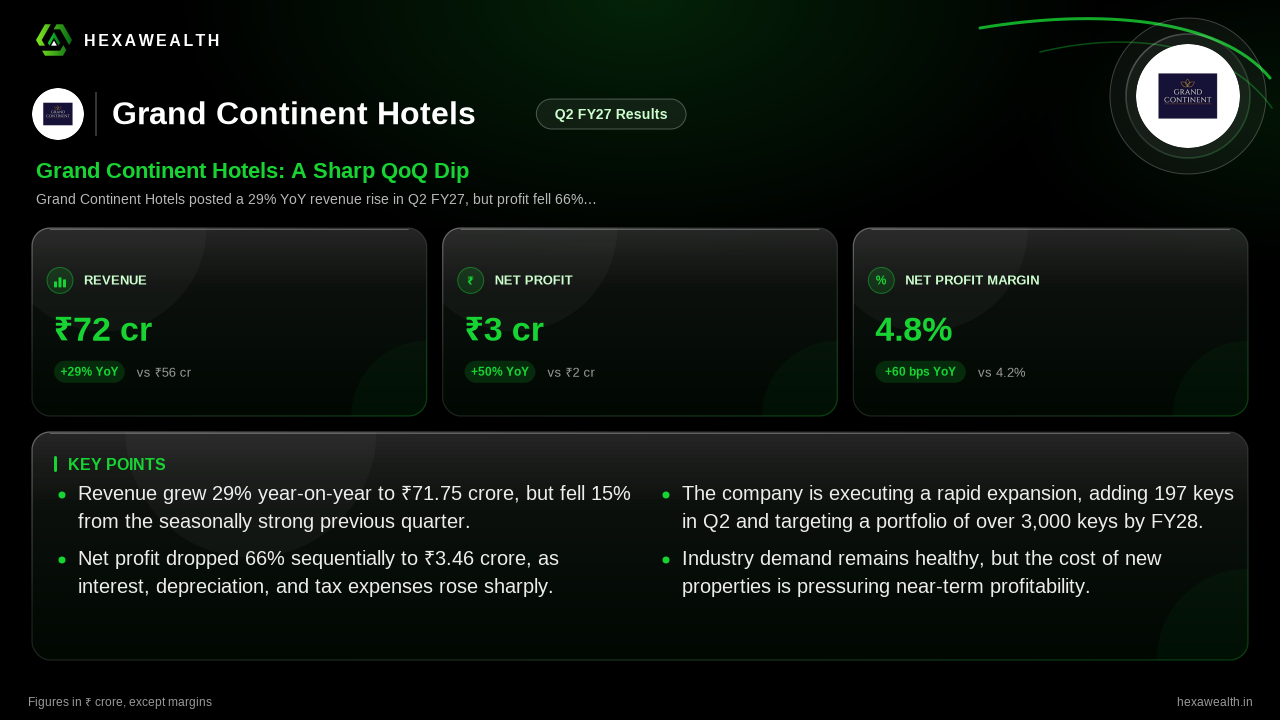
Grand Continent Hotels posted a 29% YoY revenue rise in Q2 FY27, but profit fell 66% sequentially. The sharp drop reflects higher interest, depreciation, and a significant tax expense, highlighting the cost of rapid expansion.
For a hotel chain expanding at speed, the test is turning new rooms into steady profit. Grand Continent Hotels added 197 keys last quarter, pushing revenue up 29% from a year ago. Yet profit fell sharply from the previous quarter, showing the costs of that growth are arriving faster than the earnings.
The numbers tell a story of two different comparisons. Year-on-year, the business is much larger. Sequentially, profitability has weakened considerably.
Revenue & profit
Revenue (₹ Cr)
Profit (₹ Cr)
- Revenue (₹ Cr), Q2 FY25 (Sep 2024): 32.00
- Revenue (₹ Cr), Q4 FY25 (Mar 2025): 40.78
- Revenue (₹ Cr), Q2 FY26 (Sep 2025): 55.71
- Revenue (₹ Cr), Q4 FY26 (Mar 2026): 84.83
- Revenue (₹ Cr), Q2 FY27 (Sep 2026): 71.75
- Profit (₹ Cr), Q2 FY25 (Sep 2024): 6.00
- Profit (₹ Cr), Q4 FY25 (Mar 2025): 4.41
- Profit (₹ Cr), Q2 FY26 (Sep 2025): 2.31
- Profit (₹ Cr), Q4 FY26 (Mar 2026): 10.10
- Profit (₹ Cr), Q2 FY27 (Sep 2026): 3.46
Revenue (₹ Cr)
- Revenue (₹ Cr), Q2 FY25 (Sep 2024): 32.00
- Revenue (₹ Cr), Q4 FY25 (Mar 2025): 40.78
- Revenue (₹ Cr), Q2 FY26 (Sep 2025): 55.71
- Revenue (₹ Cr), Q4 FY26 (Mar 2026): 84.83
- Revenue (₹ Cr), Q2 FY27 (Sep 2026): 71.75
Profit (₹ Cr)
- Profit (₹ Cr), Q2 FY25 (Sep 2024): 6.00
- Profit (₹ Cr), Q4 FY25 (Mar 2025): 4.41
- Profit (₹ Cr), Q2 FY26 (Sep 2025): 2.31
- Profit (₹ Cr), Q4 FY26 (Mar 2026): 10.10
- Profit (₹ Cr), Q2 FY27 (Sep 2026): 3.46
Net Profit Margin
- Net Profit Margin, Q2 FY25 (Sep 2024): 18.8%
- Net Profit Margin, Q4 FY25 (Mar 2025): 10.8%
- Net Profit Margin, Q2 FY26 (Sep 2025): 4.2%
- Net Profit Margin, Q4 FY26 (Mar 2026): 11.9%
- Net Profit Margin, Q2 FY27 (Sep 2026): 4.8%
| Metric | CurrentQ2 FY27 (Sep 2026) | PreviousQ4 FY26 (Mar 2026) |
|---|---|---|
| Revenue (₹ Cr) | 71.75 | 84.83 |
| Profit (₹ Cr) | 3.46 | 10.10 |
| Net Profit Margin | 4.8% | 11.9% |
Revenue fell 15% from the March quarter, a typical seasonal shift for the industry. Profit, however, dropped 66%, far outpacing the top-line decline. The net profit margin compressed by 710 basis points sequentially to just 4.8%.
The costs that arrived with new keys
Several line items squeezed the bottom line. Interest expense rose 75% year-on-year, reflecting the debt taken to fund expansion. Depreciation jumped 49% as new properties came online.
Most strikingly, the tax outlay surged 90% quarter-on-quarter. This suggests a lower proportion of tax-deferred items or one-time benefits in Q2 compared to the bumper Q4, where the effective tax rate was unusually low at 6%.
Live Chart
· GCHOTELS
(BSE)
ISIN: INE12E301017
Expansion is the strategy, and the pressure
Management's focus remains on scaling the portfolio. According to Alfafinder, the company added 197 keys through new signings in Q2 and opened a 56-room property in Bengaluru. The target is to grow from about 1,850 keys to over 3,000 by FY28.
This asset-light, lease-led model allows for fast growth but brings fixed costs like rent, interest, and pre-opening expenses. While new hotels boost revenue, they take time to reach stable occupancy and mature margins.
The broader industry backdrop offers support. A Jefferies report cited by Punjab Kesari notes domestic travel and MICE activity remain strong, though growth may moderate as comparisons normalize. This sustained demand should help fill the new rooms Grand Continent is adding.
Key Points
- Revenue grew 29% year-on-year to ₹71.75 crore, but fell 15% from the seasonally strong previous quarter.
- Net profit dropped 66% sequentially to ₹3.46 crore, as interest, depreciation, and tax expenses rose sharply.
- The company is executing a rapid expansion, adding 197 keys in Q2 and targeting a portfolio of over 3,000 keys by FY28.
- Industry demand remains healthy, but the cost of new properties is pressuring near-term profitability.
Hexa Perspective
The quarter illustrates the classic tension of a high-growth, capital-intensive model. The year-on-year leap confirms the expansion is driving scale, but the sequential profit collapse shows operating leverage is still elusive.
Investors are paying for future market share, not current margins. The stock's P/E of 21.7 trades at a 46% discount to the industry average, pricing in this execution risk. The next few quarters will show if rising occupancy can outpace the fixed-cost drag of new signings, turning top-line growth into durable bottom-line gains.
Also read
Want this applied to your portfolio?
Talk to a HexaWealth advisor, or sync your mutual fund data for insights tailored to your holdings.