Dynavision (DYNAVSN) Q1 FY27 Profit Falls 45% Despite Higher Revenue as Solar Push Raises Costs
Dynavision's Q1 profit fell sharply from the previous quarter, weighed down by higher employee costs and a return to normal tax levels, even as its solar subsidiary drove revenue growth.
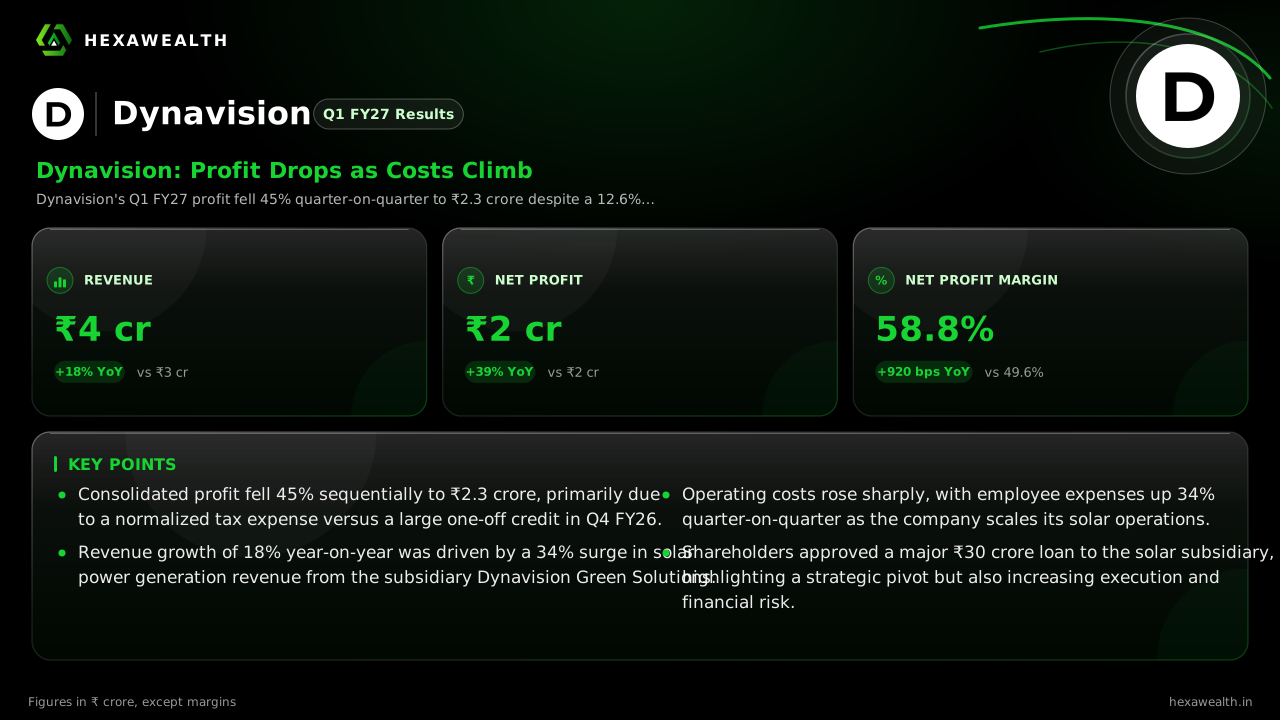
Dynavision's Q1 FY27 profit fell 45% quarter-on-quarter to ₹2.3 crore despite a 12.6% revenue rise. The decline stemmed from higher employee costs and a normalized tax expense, contrasting with a one-off tax benefit in Q4 FY26 that had inflated prior profit.
For Dynavision, the story of the June quarter is one of two halves: a growing solar business lifting revenue, and rising costs pulling profit back down. The company posted a 39% yearly profit jump but a sharp 45% sequential drop, revealing the pressures of scaling its renewable energy arm.
Revenue rose to ₹3.92 crore, up 18% from a year ago and 13% from the prior quarter. Profit, however, fell to ₹2.3 crore from ₹4.2 crore in March. The net profit margin softened to 58.8%, though it remains well above the 49.6% from a year earlier.
Revenue & profit
Revenue (₹ Cr)
Profit (₹ Cr)
- Revenue (₹ Cr), Q1 FY26: 3.32
- Revenue (₹ Cr), Q2 FY26: 3.42
- Revenue (₹ Cr), Q3 FY26: 3.32
- Revenue (₹ Cr), Q4 FY26: 3.48
- Revenue (₹ Cr), Q1 FY27: 3.92
- Profit (₹ Cr), Q1 FY26: 1.65
- Profit (₹ Cr), Q2 FY26: 0.88
- Profit (₹ Cr), Q3 FY26: 1.36
- Profit (₹ Cr), Q4 FY26: 4.20
- Profit (₹ Cr), Q1 FY27: 2.30
Revenue (₹ Cr)
- Revenue (₹ Cr), Q1 FY26: 3.32
- Revenue (₹ Cr), Q2 FY26: 3.42
- Revenue (₹ Cr), Q3 FY26: 3.32
- Revenue (₹ Cr), Q4 FY26: 3.48
- Revenue (₹ Cr), Q1 FY27: 3.92
Profit (₹ Cr)
- Profit (₹ Cr), Q1 FY26: 1.65
- Profit (₹ Cr), Q2 FY26: 0.88
- Profit (₹ Cr), Q3 FY26: 1.36
- Profit (₹ Cr), Q4 FY26: 4.20
- Profit (₹ Cr), Q1 FY27: 2.30
Net Profit Margin (%)
- Net Profit Margin (%), Q1 FY26: 49.6
- Net Profit Margin (%), Q2 FY26: 25.9
- Net Profit Margin (%), Q3 FY26: 41.0
- Net Profit Margin (%), Q4 FY26: -
- Net Profit Margin (%), Q1 FY27: 58.8
| Metric | CurrentQ1 FY27 | PreviousQ4 FY26 | Same quarter LYQ1 FY26 |
|---|---|---|---|
| Revenue (₹ Cr) | 3.92YoY +18% | 3.48 | 3.32 |
| Profit (₹ Cr) | 2.30YoY +39% | 4.20 | 1.65 |
| Net Profit Margin (%) | 58.8YoY +19% | - | 49.6 |
The Solar Engine and the Cost Catch
The growth is coming from Dynavision Green Solutions, the solar subsidiary. According to ScanX, solar power generation revenue surged 34% year-on-year to ₹1.50 crore. This segment's profit contribution jumped tenfold, becoming the group's primary profit driver.
Yet this expansion brought higher expenses. Total costs rose 20% from the previous quarter, with employee costs up 34%. The company is investing in its solar operations, and these costs are arriving before the full revenue benefits of new projects.
A Tax Anomaly Distorts the View
The steep quarterly profit drop is partly a mirage. ScanX notes the previous quarter's profit was flattered by an anomalous tax credit of ₹1.89 crore. This one-off benefit from a prior-period adjustment, as reported by Kotak Neo, made Q4's ₹4.2 crore profit an unsustainable peak.
Live Chart
· DYNAVSN
(BSE)
ISIN: INE083E01010
With tax expenses normalizing this quarter, the underlying profit before tax growth of 23% quarter-on-quarter offers a clearer picture. The business is growing, but not at the explosive rate the Q4 headline suggested.
Funding the Green Ambition
Management is betting heavily on solar. Shareholders recently approved a ₹30 crore loan to Dynavision Green Solutions, a move StockFin.ai notes represents over 190% of consolidated turnover. This capital will fund expansion, including a new 450 kW capacity addition tied to a power purchase agreement with Apollo Hospitals.
The loan signals commitment but also introduces risk. The solar EPC sector faces headwinds, with reports like one from SaurEnergy highlighting industry-wide pressures from supply-chain constraints and aggressive bidding.
Key Points
- Consolidated profit fell 45% sequentially to ₹2.3 crore, primarily due to a normalized tax expense versus a large one-off credit in Q4 FY26.
- Revenue growth of 18% year-on-year was driven by a 34% surge in solar power generation revenue from the subsidiary Dynavision Green Solutions.
- Operating costs rose sharply, with employee expenses up 34% quarter-on-quarter as the company scales its solar operations.
- Shareholders approved a major ₹30 crore loan to the solar subsidiary, highlighting a strategic pivot but also increasing execution and financial risk.
Hexa Perspective
The quarter confirms Dynavision's transition from a property-leasing company to a solar energy player is underway, with the subsidiary now the main profit contributor. The path ahead, however, is capital-intensive and faces a tightening industry environment.
The valuation at a P/E of 10, a 71% discount to the industry average, prices in these execution risks and the company's small scale. For the stock to re-rate, Dynavision must demonstrate it can deploy the new ₹30 crore loan effectively, translating capex into steady, profitable growth without further margin pressure from rising costs.
Also read
Want this applied to your portfolio?
Talk to a HexaWealth advisor, or sync your mutual fund data for insights tailored to your holdings.