Dolfin Rubbers (DOLFIN) Q2 FY27 Profit Stalls as Costs Catch Up to Record Sales
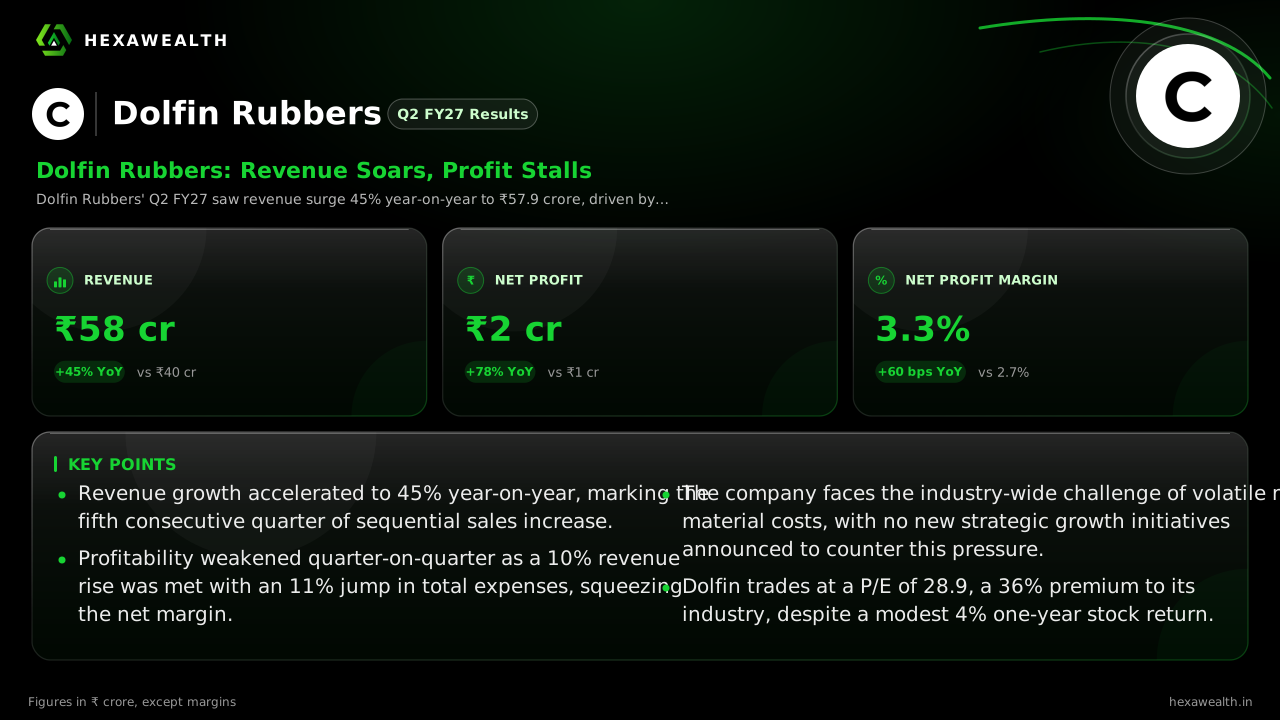
Dolfin Rubbers posted a 45% revenue jump in Q2 FY27, but net profit dipped sequentially as raw material costs and higher expenses squeezed margins.
Dolfin Rubbers' Q2 FY27 saw revenue surge 45% year-on-year to ₹57.9 crore, driven by higher sales volumes. However, net profit slipped 2% from the previous quarter to ₹1.92 crore as margins contracted under cost pressure.
For a tyre maker built on the steady demand of India's replacement market, Dolfin Rubbers' latest quarter delivered both a powerful surge and a subtle warning. Revenue jumped 45% from a year ago, yet profit slipped from the previous quarter as the cost of growth arrived.
The September quarter revenue reached ₹57.9 crore, up 10% from June. Net profit, however, edged down to ₹1.92 crore. The company's net profit margin fell 40 basis points sequentially to 3.3%.
Revenue & profit
Revenue (₹ Cr)
Profit (₹ Cr)
- Revenue (₹ Cr), Q2 FY26 (Sep 2025): 39.9
- Revenue (₹ Cr), Q3 FY26 (Dec 2025): 41.02
- Revenue (₹ Cr), Q4 FY26 (Mar 2026): 48.6
- Revenue (₹ Cr), Q1 FY27 (Jun 2026): 52.57
- Revenue (₹ Cr), Q2 FY27 (Sep 2026): 57.9
- Profit (₹ Cr), Q2 FY26 (Sep 2025): 1.08
- Profit (₹ Cr), Q3 FY26 (Dec 2025): 1.54
- Profit (₹ Cr), Q4 FY26 (Mar 2026): 1.63
- Profit (₹ Cr), Q1 FY27 (Jun 2026): 1.96
- Profit (₹ Cr), Q2 FY27 (Sep 2026): 1.92
Revenue (₹ Cr)
- Revenue (₹ Cr), Q2 FY26 (Sep 2025): 39.9
- Revenue (₹ Cr), Q3 FY26 (Dec 2025): 41.02
- Revenue (₹ Cr), Q4 FY26 (Mar 2026): 48.6
- Revenue (₹ Cr), Q1 FY27 (Jun 2026): 52.57
- Revenue (₹ Cr), Q2 FY27 (Sep 2026): 57.9
Profit (₹ Cr)
- Profit (₹ Cr), Q2 FY26 (Sep 2025): 1.08
- Profit (₹ Cr), Q3 FY26 (Dec 2025): 1.54
- Profit (₹ Cr), Q4 FY26 (Mar 2026): 1.63
- Profit (₹ Cr), Q1 FY27 (Jun 2026): 1.96
- Profit (₹ Cr), Q2 FY27 (Sep 2026): 1.92
Net Profit Margin
- Net Profit Margin, Q2 FY26 (Sep 2025): 2.7%
- Net Profit Margin, Q3 FY26 (Dec 2025): 3.7%
- Net Profit Margin, Q4 FY26 (Mar 2026): 3.4%
- Net Profit Margin, Q1 FY27 (Jun 2026): 3.7%
- Net Profit Margin, Q2 FY27 (Sep 2026): 3.3%
| Metric | CurrentQ2 FY27 (Sep 2026) | PreviousQ1 FY27 (Jun 2026) |
|---|---|---|
| Revenue (₹ Cr) | 57.9 | 52.57 |
| Profit (₹ Cr) | 1.92 | 1.96 |
| Net Profit Margin | 3.3% | 3.7% |
The volume surge and the cost pinch
The strong top-line growth was driven by higher sales volumes, as reported by Scanx.trade. This operating leverage helped profit before tax jump 116% year-on-year. Yet, total expenses grew nearly 11% quarter-on-quarter, outpacing revenue growth.
Raw material costs are the wildcard for this business, with inputs like natural rubber being "extremely unpredictable," notes a StockScans report. The broader industry is feeling this pinch, with major players like Apollo Tyres citing raw material costs rising in the high teens sequentially and planning further price hikes.
A cautious outlook with no clear guidance
Management provided no explicit forward guidance in its latest filings or during its recent AGM, according to StockFin.ai. The absence of new capacity announcements suggests a focus on operational consolidation rather than aggressive expansion.
Live Chart
· DOLFIN
(BSE)
ISIN: INE666Y01010
This comes as the company's inventory rose 13.7% since March, as noted by Scanx.trade, indicating working capital is being absorbed by stock build-up. The financial position remains stable with a debt-to-equity ratio of 0.48.
Key Points
- Revenue growth accelerated to 45% year-on-year, marking the fifth consecutive quarter of sequential sales increase.
- Profitability weakened quarter-on-quarter as a 10% revenue rise was met with an 11% jump in total expenses, squeezing the net margin.
- The company faces the industry-wide challenge of volatile raw material costs, with no new strategic growth initiatives announced to counter this pressure.
- Dolfin trades at a P/E of 28.9, a 36% premium to its industry, despite a modest 4% one-year stock return.
Hexa Perspective
The quarter reveals a business hitting its stride on volumes but struggling to convert that into consistent earnings. The year-on-year profit leap is impressive, yet the sequential margin decline shows costs are rising as fast as sales.
The path forward hinges on pricing power in a competitive replacement market and management's ability to navigate input cost volatility. Without new growth catalysts, the current premium valuation appears to be pricing in a margin recovery that has yet to materialize.
Also read
Want this applied to your portfolio?
Talk to a HexaWealth advisor, or sync your mutual fund data for insights tailored to your holdings.