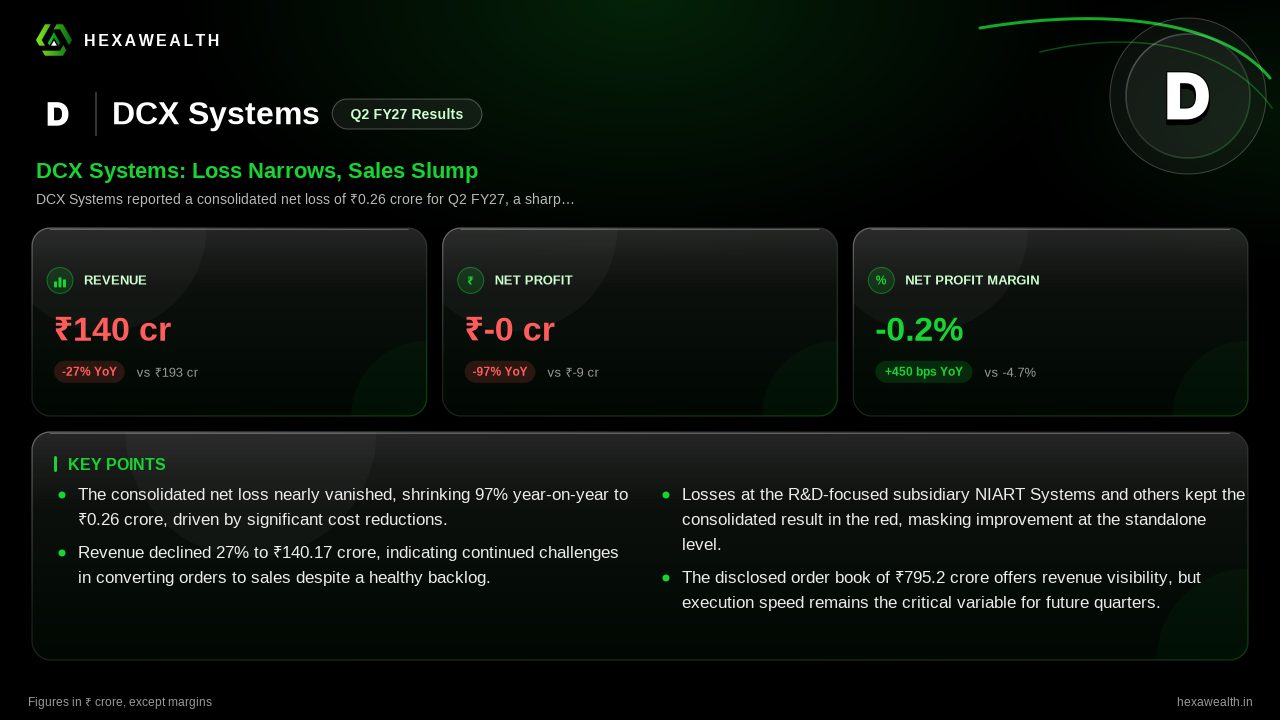
DCX Systems (DCXINDIA) Q2 FY27 Loss Narrows to a Sliver as Sales Fall 27%
The defence electronics maker's quarterly loss shrank 97% year-on-year, but revenue fell sharply due to lower operational volumes.
DCX Systems reported a consolidated net loss of ₹0.26 crore for Q2 FY27, a sharp improvement from last year's ₹9.04 crore loss. Revenue, however, declined 27% to ₹140.17 crore, reflecting lower execution volumes.
For DCX Systems, the story of the September quarter is a tale of two halves: a dramatically shrinking loss and a stubbornly shrinking top line. The defence electronics specialist is managing costs better, but its core challenge remains converting a large order book into consistent revenue.
The numbers show a stark divergence. Revenue fell 27.3% year-on-year to ₹140.17 crore. Yet, the net loss narrowed to just ₹0.26 crore from ₹9.04 crore a year ago, a 97% improvement. The net profit margin improved to -0.2% from -4.7%.
Revenue & profit
Revenue (₹ Cr)
Profit (₹ Cr)
- Revenue (₹ Cr), Q2 FY26 (Sep 2025): 192.85
- Revenue (₹ Cr), Q3 FY26 (Dec 2025): 121.06
- Revenue (₹ Cr), Q4 FY26 (Mar 2026): 207.27
- Revenue (₹ Cr), Q1 FY27 (Jun 2026): 103.12
- Revenue (₹ Cr), Q2 FY27 (Sep 2026): 140.17
- Profit (₹ Cr), Q2 FY26 (Sep 2025): -9.04
- Profit (₹ Cr), Q3 FY26 (Dec 2025): -2.43
- Profit (₹ Cr), Q4 FY26 (Mar 2026): -0.30
- Profit (₹ Cr), Q1 FY27 (Jun 2026): -8.66
- Profit (₹ Cr), Q2 FY27 (Sep 2026): -0.26
Revenue (₹ Cr)
- Revenue (₹ Cr), Q2 FY26 (Sep 2025): 192.85
- Revenue (₹ Cr), Q3 FY26 (Dec 2025): 121.06
- Revenue (₹ Cr), Q4 FY26 (Mar 2026): 207.27
- Revenue (₹ Cr), Q1 FY27 (Jun 2026): 103.12
- Revenue (₹ Cr), Q2 FY27 (Sep 2026): 140.17
Profit (₹ Cr)
- Profit (₹ Cr), Q2 FY26 (Sep 2025): -9.04
- Profit (₹ Cr), Q3 FY26 (Dec 2025): -2.43
- Profit (₹ Cr), Q4 FY26 (Mar 2026): -0.30
- Profit (₹ Cr), Q1 FY27 (Jun 2026): -8.66
- Profit (₹ Cr), Q2 FY27 (Sep 2026): -0.26
Net Profit Margin %
- Net Profit Margin %, Q2 FY26 (Sep 2025): -4.7
- Net Profit Margin %, Q3 FY26 (Dec 2025): -2.0
- Net Profit Margin %, Q4 FY26 (Mar 2026): -0.1
- Net Profit Margin %, Q1 FY27 (Jun 2026): -8.4
- Net Profit Margin %, Q2 FY27 (Sep 2026): -0.2
| Metric | CurrentQ2 FY27 (Sep 2026) | PreviousQ1 FY27 (Jun 2026) |
|---|---|---|
| Revenue (₹ Cr) | 140.17 | 103.12 |
| Profit (₹ Cr) | -0.26 | -8.66 |
| Net Profit Margin % | -0.2 | -8.4 |
Why profits improved as sales fell
A sharp 43.5% cut in employee costs, down to ₹9.4 crore, was a primary driver of the bottom-line improvement, according to the quarterly analysis. This, alongside lower material costs, helped offset the revenue decline. The standalone entity even reported a profit of ₹4.3 crore, as noted by scanx.trade.
However, the consolidated result stayed in the red because of losses at subsidiaries. Raneal Advanced Systems and the R&D-stage NIART Systems together reported a net loss of ₹4.5 crore for the quarter, offsetting the parent's gains.
The backlog and the execution gap
The company's future hinges on its ability to execute. DCX Systems disclosed an order book of ₹795.2 crore as of September 2026, according to an ALFA finder report. This provides a clear line of sight for future revenue.
Live Chart
· DCXINDIA
(BSE)
ISIN: INE0KL801015
Yet, the 27% yearly sales drop points to a persistent execution gap. Management had previously cited supply-chain disruptions and schedule delays, and this quarter's low revenue suggests those headwinds have not fully abated.
Key Points
- The consolidated net loss nearly vanished, shrinking 97% year-on-year to ₹0.26 crore, driven by significant cost reductions.
- Revenue declined 27% to ₹140.17 crore, indicating continued challenges in converting orders to sales despite a healthy backlog.
- Losses at the R&D-focused subsidiary NIART Systems and others kept the consolidated result in the red, masking improvement at the standalone level.
- The disclosed order book of ₹795.2 crore offers revenue visibility, but execution speed remains the critical variable for future quarters.
Hexa Perspective
The quarter reveals a company in transition, tightening its operations while waiting for project execution to catch up with order intake. The near-break-even at the consolidated level is a positive step, but it's built on cost control, not sales growth.
Investors are weighing a strong order book against a weak revenue trend. The stock's 29% decline over the past year reflects this tension. The next few quarters will test whether DCX Systems can bridge the gap between its promising pipeline and its quarterly financial delivery.
Also read
Want this applied to your portfolio?
Talk to a HexaWealth advisor, or sync your mutual fund data for insights tailored to your holdings.