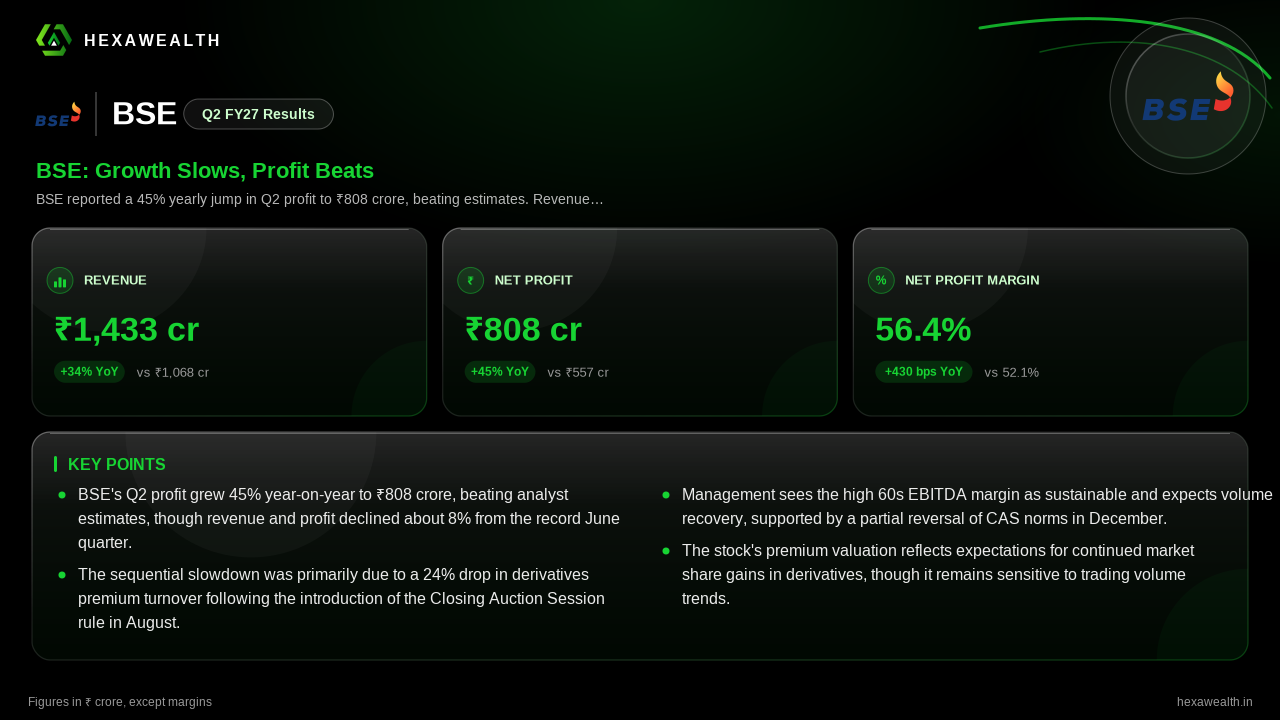
BSE reported a 45% yearly jump in Q2 profit to ₹808 crore, beating estimates. Revenue grew 34% but fell 8.5% from the prior quarter, reflecting a slowdown in derivatives trading after a record Q1.
For BSE, the September quarter was a test of momentum after a record-breaking June. The exchange's rapid gains in equity derivatives, its primary growth engine, faced a temporary headwind from a new market rule.
The numbers show a business still growing strongly from a year ago but cooling from its peak. Revenue of ₹1,433 crore and profit of ₹808 crore represent yearly jumps of 34% and 45%, respectively. Sequentially, both metrics dipped by roughly 8%.
Revenue & profit
Revenue (₹ Cr)
Profit (₹ Cr)
Net Profit Margin
Metric
CurrentQ2 FY27
PreviousQ1 FY27
Same quarter LYQ2 FY26
Revenue (₹ Cr)
1,432.7YoY +34%
1,566.0
1,068.4
Profit (₹ Cr)
807.5YoY +45%
872.7
557.0
Net Profit Margin
56.4%YoY +8.3%
55.7%
52.1%
The sequential moderation was anticipated. According to NDTV Profit, the key driver was a 24% quarter-on-quarter drop in average daily premium turnover for equity derivatives. This followed the market regulator's introduction of a Closing Auction Session (CAS) in August.
The rule change spurred end-of-day volatility, leading intraday traders to scale back bets. Centrum Broking noted the sector's index options premium turnover fell 27% sequentially in Q2. This directly pressured BSE's transaction charges, its largest revenue stream.
The Momentum Check
Despite the quarterly dip, the underlying annual growth story remains robust. The exchange's net profit margin expanded to 56.4%, up 430 basis points from a year ago. Management, on the earnings call, stated that EBITDA margins of 67-68% appear sustainable given disciplined cost controls.
The outlook hinges on a rebound in derivatives activity. Management highlighted a “decisive recovery” in September, with October setting a new monthly record for index options premium turnover. A partial reversal of the CAS norms, effective December 7, is seen by brokerages like Motilal Oswal as a structural catalyst for volumes.
Market Read and Valuation
The results beat Street estimates. Zee Business reported BSE's profit of ₹809 crore surpassed the expected ₹748 crore, while the EBITDA margin of 68.7% was also ahead of consensus. Following the print, Motilal Oswal upgraded the stock to ‘Buy’, citing the CAS reversal and sustained premium market share above 30%.
However, the stock trades at a significant premium. With a P/E of 53 against an industry average of 42.6, investors are pricing in superior growth from a smaller base. This valuation, as noted by Santosh Meena of Swastika Investmart, is driven by BSE's faster earnings trajectory compared to its larger rival.
Key Points
BSE's Q2 profit grew 45% year-on-year to ₹808 crore, beating analyst estimates, though revenue and profit declined about 8% from the record June quarter.
The sequential slowdown was primarily due to a 24% drop in derivatives premium turnover following the introduction of the Closing Auction Session rule in August.
Management sees the high 60s EBITDA margin as sustainable and expects volume recovery, supported by a partial reversal of CAS norms in December.
The stock's premium valuation reflects expectations for continued market share gains in derivatives, though it remains sensitive to trading volume trends.
“
Hexa Perspective
The quarter confirms BSE's derivatives-led growth model is intact but not immune to short-term regulatory friction. The sequential dip is a pause, not a reversal, with October activity already hitting new highs.
The key watchpoint is whether the exchange can convert this volatility-sensitive rebound into steady market share gains in cash equities and monthly options, segments where it still lags. Its premium valuation leaves little room for missteps, squarely tying its fortunes to the durability of the derivatives momentum post-December.
Talk to a HexaWealth advisor, or sync your mutual fund data for insights tailored to your holdings.
Frequently asked questions
What were BSE's Q2 FY27 results?
For the quarter ended September 2026, BSE reported a consolidated net profit of ₹807.5 crore, a 45% increase from the same quarter last year. Revenue from operations stood at ₹1,432.7 crore, up 34% year-on-year.
Why did BSE's Q2 FY27 profit and revenue decline from the previous quarter?
BSE's Q2 profit and revenue fell about 8% sequentially from Q1 FY27. This was primarily due to a moderation in equity derivatives activity, with average daily premium turnover dropping 24% after the market regulator introduced a new Closing Auction Session rule in August.
What was BSE's net profit margin in Q2 FY27?
BSE's net profit margin was 56.4% in Q2 FY27. This represents an improvement of 430 basis points from the 52.1% margin reported in the same quarter last year, reflecting strong operating leverage.
Did BSE's Q2 FY27 results beat analyst estimates?
Yes, BSE's Q2 results beat Street estimates. According to Zee Business, the reported net profit of ₹809 crore surpassed the consensus estimate of ₹748 crore. The EBITDA margin of 68.7% also exceeded the expected 66.3%.
What is the outlook for BSE's derivatives segment?
Management noted a recovery in derivatives activity in September, with October setting a record. A partial reversal of the recent Closing Auction Session rules in December 2026 is expected by analysts to support a rebound in trading volumes and premium turnover.
What did BSE management say about margins in the earnings call?
In the Q2 earnings call, BSE's management stated that the current EBITDA margin in the 67-68% range appears sustainable. They attributed this to disciplined cost controls, as key variable costs like regulatory fees are largely outside their direct control.
What are BSE's capital expenditure plans for FY27?
Management clarified there is no plan to slow down capital expenditure. While cash outflow was lower in H1, commitments are in place. They are expanding co-location infrastructure, planning to add 170-190 more server racks to meet client demand.
How did BSE's primary market (IPO) business perform in Q2 FY27?
The primary market was very strong. According to the earnings call, September 2026 alone saw a record 32 mainboard IPO listings on BSE, raising over ₹40,000 crore. The SME platform also crossed 800 listed companies in October.
What is BSE's valuation compared to the industry?
BSE trades at a premium to its industry. Its P/E ratio is 53, which is about 24% higher than the industry average P/E of 42.6. Analysts attribute this to its faster earnings growth from a smaller base compared to peers.
Did any brokerage change its rating on BSE stock after Q2 results?
Yes, Motilal Oswal upgraded BSE to a 'Buy' rating after the Q2 results, with a price target of ₹4,000. The upgrade cited the expected reversal of CAS norms in December and BSE's sustained market share in index options.
BSE Q2 net profit rises 45% to ₹809 crore, revenue up 34%
For the September quarter of FY27, BSE reported a 45% year-on-year increase in consolidated net profit to ₹809 crore. Revenue from operations grew 34% to ₹1,433 crore, driven by transaction charges and investment income.
BSE Q2 results: Profit dips sequentially
BSE's Q2 FY27 consolidated net profit declined 7.4% sequentially to ₹809 crore from ₹874 crore in the June quarter. Revenue also fell 8.5% quarter-on-quarter, reflecting lower derivatives trading activity during the period.
BSE Q2 results beat Street estimates
BSE's Q2 FY27 results exceeded analyst expectations. The reported net profit of ₹809 crore was higher than the Zee Business estimate of ₹748 crore. The EBITDA margin of 68.7% also beat the consensus forecast of 66.3%.
Why did BSE derivatives turnover fall in Q2?
BSE's equity derivatives average daily premium turnover fell 24% sequentially in Q2 FY27. This decline was largely attributed to the market regulator's introduction of a Closing Auction Session in August, which increased end-of-day volatility and tempered intraday trading activity.
BSE management guidance on margins
BSE management, during the Q2 FY27 earnings call, stated that the current EBITDA margin of 67-68% appears sustainable. They highlighted disciplined cost control, though key expenses like regulatory and clearing fees remain variable with volumes.