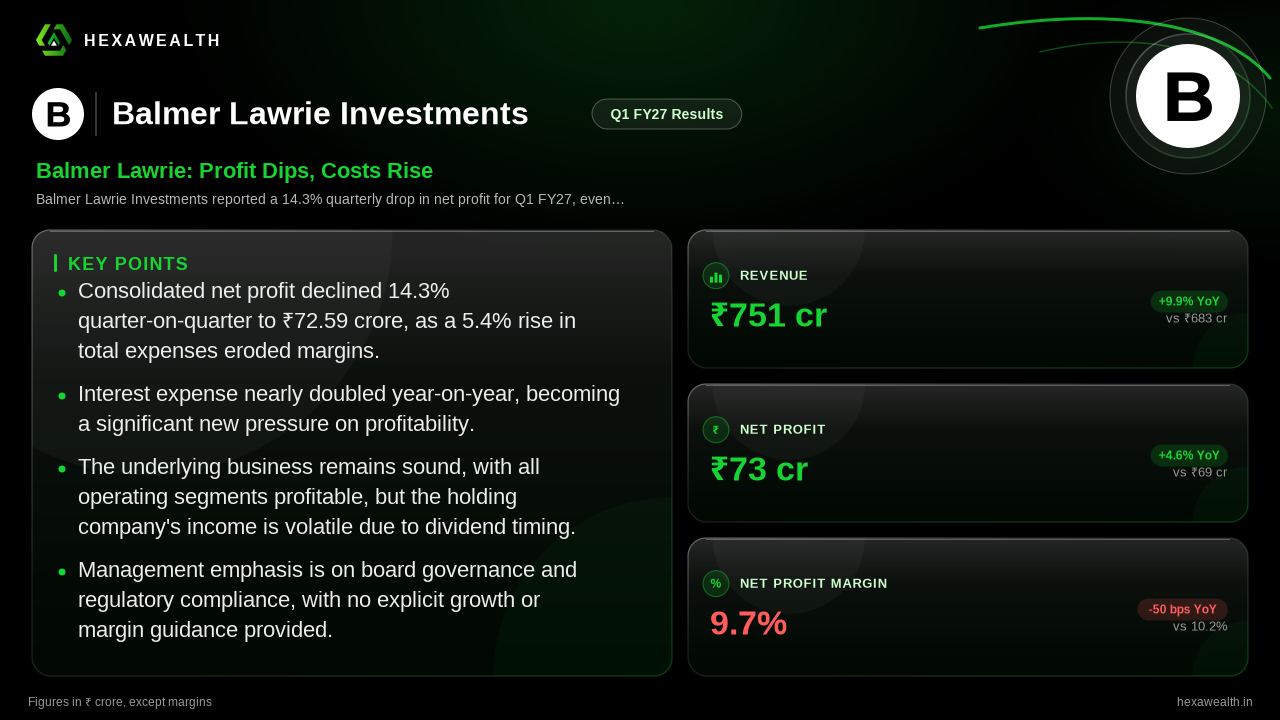
The holding company's consolidated profit fell sequentially despite higher revenue, as rising expenses and a sharp jump in interest costs squeezed margins.
Balmer Lawrie Investments reported a 14.3% quarterly drop in net profit for Q1 FY27, even as revenue grew modestly. The decline was driven by a 5.4% rise in total expenses and a near-doubling of interest costs year-on-year.
For Balmer Lawrie Investments, a stable top line this quarter was overshadowed by costs that rose faster. The holding company's consolidated revenue edged up 0.6% sequentially to ₹751.14 crore, but net profit fell 14.3% to ₹72.59 crore.
The numbers show a clear squeeze. Revenue grew 9.9% from a year ago, yet profit grew only 4.6% over the same period. The net profit margin contracted 50 basis points year-on-year and a sharper 160 basis points from the previous quarter.
Revenue & profit
Revenue (₹ Cr)
Profit (₹ Cr)
Revenue (₹ Cr), Q1 FY26 (Jun 2025): 683.48
Revenue (₹ Cr), Q2 FY26 (Sep 2025): 638.39
Revenue (₹ Cr), Q3 FY26 (Dec 2025): 659.35
Revenue (₹ Cr), Q4 FY26 (Mar 2026): 746.32
Revenue (₹ Cr), Q1 FY27 (Jun 2026): 751.14
Profit (₹ Cr), Q1 FY26 (Jun 2025): 69.41
Profit (₹ Cr), Q2 FY26 (Sep 2025): 57.10
Profit (₹ Cr), Q3 FY26 (Dec 2025): 66.57
Profit (₹ Cr), Q4 FY26 (Mar 2026): 84.68
Profit (₹ Cr), Q1 FY27 (Jun 2026): 72.59
Revenue (₹ Cr)
Revenue (₹ Cr), Q1 FY26 (Jun 2025): 683.48
Revenue (₹ Cr), Q2 FY26 (Sep 2025): 638.39
Revenue (₹ Cr), Q3 FY26 (Dec 2025): 659.35
Revenue (₹ Cr), Q4 FY26 (Mar 2026): 746.32
Revenue (₹ Cr), Q1 FY27 (Jun 2026): 751.14
Profit (₹ Cr)
Profit (₹ Cr), Q1 FY26 (Jun 2025): 69.41
Profit (₹ Cr), Q2 FY26 (Sep 2025): 57.10
Profit (₹ Cr), Q3 FY26 (Dec 2025): 66.57
Profit (₹ Cr), Q4 FY26 (Mar 2026): 84.68
Profit (₹ Cr), Q1 FY27 (Jun 2026): 72.59
Net Profit Margin (%)
Net Profit Margin (%), Q1 FY26 (Jun 2025): 10.2
Net Profit Margin (%), Q2 FY26 (Sep 2025): 8.9
Net Profit Margin (%), Q3 FY26 (Dec 2025): 10.1
Net Profit Margin (%), Q4 FY26 (Mar 2026): 11.3
Net Profit Margin (%), Q1 FY27 (Jun 2026): 9.7
Metric
CurrentQ1 FY27 (Jun 2026)
PreviousQ4 FY26 (Mar 2026)
Revenue (₹ Cr)
751.14
746.32
Profit (₹ Cr)
72.59
84.68
Net Profit Margin (%)
9.7
11.3
Why the bottom line shrank
Total expenses rose 5.4% quarter-on-quarter, outpacing the minimal revenue growth. A key pressure point was a 90.8% year-on-year surge in interest cost to ₹12.84 crore, as reported by Kotakneo. This suggests higher working capital needs or borrowing costs.
Employee costs also increased 8.5% sequentially. While other income fell sharply from the previous quarter, this was partly offset by a lower tax outgo. The result was profit before tax dropping 18.1% from Q4 FY26.
A tale of two ledgers
A report from Stockwatch.live highlights a critical divergence. The standalone books of the holding company, which records dividend income from its subsidiary Balmer Lawrie & Co., showed a 49% year-on-year profit drop. This was due to a timing difference in dividend receipts.
Live Chart
· BLIL
(BSE)
ISIN: INE525F01025
In contrast, the consolidated performance, which captures the operating profits of all subsidiaries, tells a healthier underlying story. Every major segment—Industrial Packaging, Logistics Services, Travel & Vacations—was profitable this quarter.
Governance over guidance
Management provided no formal financial guidance, according to an analysis by StockFin.ai. The focus remained on governance, with new government-nominated and independent directors joining the board. The company also declared a final dividend of ₹2.27 per share for FY26.
The firm faces recurring regulatory friction. It recently noted fines from stock exchanges for compliance lapses, which it attributes to delays in government director appointments.
Key Points
Consolidated net profit declined 14.3% quarter-on-quarter to ₹72.59 crore, as a 5.4% rise in total expenses eroded margins.
Interest expense nearly doubled year-on-year, becoming a significant new pressure on profitability.
The underlying business remains sound, with all operating segments profitable, but the holding company's income is volatile due to dividend timing.
Management emphasis is on board governance and regulatory compliance, with no explicit growth or margin guidance provided.
“
Hexa Perspective
The quarter underscores the dual nature of Balmer Lawrie as an investment holding company. The consolidated operations are steady, but the parent's earnings are subject to the lumpiness of dividend flows from its subsidiary.
The sharp rise in interest cost, against a conservative debt-to-equity ratio of 0.05, warrants watching. It may indicate tighter liquidity or higher rates on short-term borrowings. With a trailing P/E of 8.1, a significant discount to the industry, the market is pricing in this stagnation and the structural challenges of a government-controlled holding company.
Talk to a HexaWealth advisor, or sync your mutual fund data for insights tailored to your holdings.
Frequently asked questions
What were Balmer Lawrie Investments' Q1 FY27 results?
For Q1 FY27 (quarter ended June 2026), Balmer Lawrie Investments reported consolidated revenue of ₹751.14 crore and a net profit of ₹72.59 crore. Revenue grew 9.9% year-on-year, while profit increased 4.6%. However, profit declined 14.3% compared to the previous quarter (Q4 FY26).
Why did Balmer Lawrie Investments' profit decline 14.3% QoQ in Q1 FY27 despite a slight revenue increase?
Balmer Lawrie's Q1 profit fell sequentially because total expenses rose 5.4%, outpacing the 0.6% revenue growth. A key driver was a significant increase in interest costs. Profit before tax dropped 18.1% quarter-on-quarter, leading to the lower net profit.
What caused the 160 bps QoQ drop in net profit margin for Balmer Lawrie Investments in Q1 FY27?
The net profit margin fell to 9.7% in Q1 FY27 from 11.3% in Q4 FY26 due to margin compression. Expenses grew faster than revenue, with a notable 33.6% quarterly jump in interest cost and an 8.5% rise in employee cost squeezing profitability.
Why did interest expense for Balmer Lawrie Investments nearly double year-on-year in Q1 FY27?
Balmer Lawrie's interest expense surged 90.8% year-on-year to ₹12.84 crore in Q1 FY27. While the company maintains a low debt-to-equity ratio, this sharp increase likely reflects higher working capital requirements or increased borrowing costs during the quarter.
What was Balmer Lawrie Investments management's commentary and guidance in the Q1 FY27 earnings?
Management did not provide explicit financial guidance for future quarters, according to an analysis by StockFin.ai. The board's focus was on governance, including new director appointments and compliance with regulatory norms, rather than outlining specific growth or margin targets.
Did Balmer Lawrie Investments announce any dividend alongside Q1 FY27 results?
Yes. The company announced a final dividend of ₹2.27 per equity share for the financial year 2025-26 (FY26). The record date for the dividend was set for September 14, 2026, with payment to be made within 30 days of declaration at the AGM.
What were the analyst estimates for Balmer Lawrie Investments Q1 FY27 and did the results beat or miss?
Balmer Lawrie Investments is a thinly covered stock. A report from Stockwatch.live states that no dedicated analyst consensus or company guidance was available to grade the Q1 FY27 results against, making a beat or miss assessment difficult.
Which brokerages have changed their rating or target price for Balmer Lawrie Investments after Q1 FY27 results?
There is no evidence of brokerages issuing new ratings or changing target prices for Balmer Lawrie Investments specifically after the Q1 FY27 results. The stock generally has limited analyst coverage.
Are mutual funds and FIIs increasing or decreasing their stake in Balmer Lawrie Investments recently?
Foreign Institutional Investor (FII) stake in Balmer Lawrie Investments slightly decreased to 0.87% in Q2 FY27 from 1.06% in Q4 FY26, as per StockFin.ai. Domestic Institutional Investor (DII) holding remains negligible, while promoter holding is steady at 59.7%.
How did Balmer Lawrie Investments stock price react on the day of Q1 FY27 results announcement?
The stock closed at ₹70.94 on August 14, 2026, the results announcement date. Historical data suggests muted immediate reaction, with the stock trading in a narrow range around ₹71 in the subsequent days, indicating the market had largely priced in the quarterly performance.
What are the key regulatory or governance risks for Balmer Lawrie Investments as a government enterprise?
A key risk is dependency on government appointments for board composition, which has led to fines from stock exchanges for missing compliance deadlines. The company has cited delays in ministry appointments as the cause for these governance lapses.
What is the cash flow and working capital situation for Balmer Lawrie Investments in Q1 FY27?
Specific Q1 cash flow figures are not in the reported results. However, for the full year FY26, the company reported strong operating cash flow of ₹289 crore. The sharp rise in Q1 FY27 interest expense suggests potential pressure on working capital management during the quarter.
Balmer Lawrie Investments Q1 FY27 results August 2026
Balmer Lawrie Investments announced its Q1 FY27 results on August 14, 2026. For the quarter ended June 2026, consolidated revenue was ₹751.14 crore and net profit was ₹72.59 crore, marking a 9.9% yearly revenue growth but a 14.3% sequential profit decline.
Balmer Lawrie Investments Q1 FY27 revenue
Balmer Lawrie Investments' consolidated revenue for Q1 FY27 (June 2026 quarter) was ₹751.14 crore. This represents a 9.9% increase from the ₹683.48 crore reported in the same quarter last year (Q1 FY26) and a slight 0.6% rise from the previous quarter (Q4 FY26).
Balmer Lawrie Investments net profit Q1 FY27
Balmer Lawrie Investments reported a consolidated net profit of ₹72.59 crore for Q1 FY27 (June 2026 quarter). This was a 4.6% increase from the ₹69.41 crore profit in Q1 FY26, but a 14.3% decrease from the ₹84.68 crore profit in the immediate preceding quarter (Q4 FY26).