Ameenji Rubber (AMEENJI) Q4 FY26's Profit Squeeze Deepens as Raw Material Costs Bite
Ameenji Rubber's Q4 revenue jumped 88% but profit fell 50%, highlighting a severe margin squeeze from surging raw material costs that extended into a loss for H1 FY27.
Ameenji Rubber's March quarter saw revenue nearly double, but profit halved as costs soared. The full-year picture shows sales up 31% while profit fell 18%, with a sharp drop in operating cash flow. New railway orders provide visibility, but cost pressures remain intense.
For a rubber products maker tied to railway and infrastructure spending, a booming top line is the goal. Ameenji Rubber's fourth quarter delivered that, but the cost of getting there wiped out most of the reward.
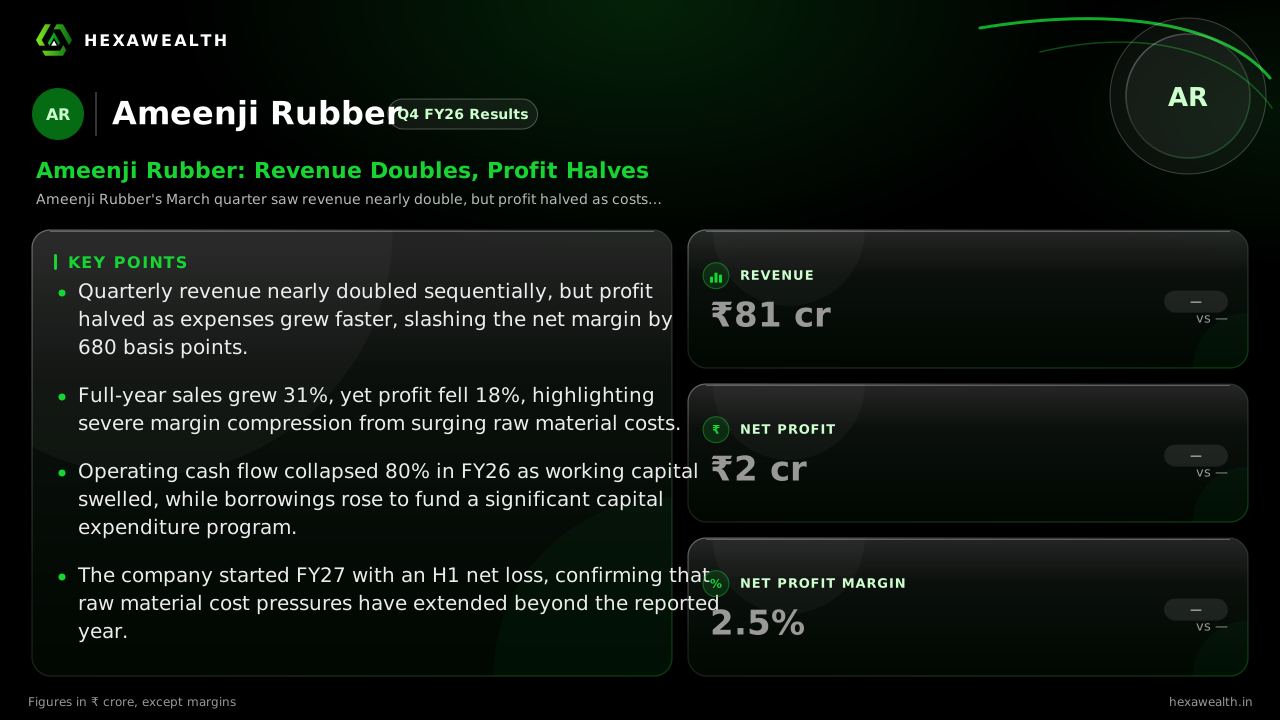
The March quarter revenue surged 88% sequentially to ₹81 crore. Yet net profit halved to ₹2 crore, dragging the quarterly net margin down to 2.5% from 9.3%. For the full year, sales grew a robust 31% to ₹123.25 crore, but profit declined 18% to ₹6.34 crore.
Revenue & profit
Revenue (₹ Cr)
Profit (₹ Cr)
Revenue (₹ Cr), Q2 FY25: 39.0
Revenue (₹ Cr), Q2 FY26: 43.0
Revenue (₹ Cr), Q4 FY26: 81.0
Profit (₹ Cr), Q2 FY25: 2.0
Profit (₹ Cr), Q2 FY26: 4.0
Profit (₹ Cr), Q4 FY26: 2.0
Revenue (₹ Cr)
Revenue (₹ Cr), Q2 FY25: 39.0
Revenue (₹ Cr), Q2 FY26: 43.0
Revenue (₹ Cr), Q4 FY26: 81.0
Profit (₹ Cr)
Profit (₹ Cr), Q2 FY25: 2.0
Profit (₹ Cr), Q2 FY26: 4.0
Profit (₹ Cr), Q4 FY26: 2.0
Metric
CurrentQ4 FY26
Revenue (₹ Cr)
81.0
Profit (₹ Cr)
2.0
Net Margin (%)
2.5
Why the boom didn't reach the bottom line
A single line explains the squeeze: total expenses jumped 111% in the quarter, far outpacing the 88% revenue growth. According to MarketPing, raw materials make up 64.4% of Ameenji's costs. The company's filings show the material cost ratio in the March quarter hit 74% of sales, a sharp rise from 44% in the September quarter.
This aligns with industry-wide pain. Reports from The Economic Times and Radial Insights note natural rubber prices surged past ₹100 per kg and even touched ₹300/kg in November 2026. For a materials-intensive business, this is a direct hit to profitability.
The cash flow and debt trade-off
Aggressive growth consumed cash. Operating cash flow plunged 80% year-on-year to ₹1.64 crore in FY26. The annual cash conversion cycle stretched to 128 days. To fund a ₹29.45 crore capital expenditure push—aimed at capacity expansion—the company borrowed heavily.
Live Chart
· AMEENJI
(BSE)
ISIN: INE14QA01016
Total borrowings rose to ₹54.94 crore, and the cash balance increased to ₹5.47 crore. The investment is strategic, targeting railway demand where Ameenji can supply up to 50% of India's annual need, as its CFO noted in an interview. But it leaves the balance sheet more leveraged.
A strained start to the new year
The cost pressure did not ease. For the half-year ended September 2026, Ameenji reported a net loss of ₹5.34 crore despite an 11.7% rise in revenue, as noted in filings on Stocksigma.ai. Higher raw material and finance costs were again the drivers.
Visibility comes from new orders, including a ₹15.49 crore contract from Central Railway. Analysis by mCapital.in estimates this could add about 5% to annual revenue over the next year. Yet with input costs at record highs, converting orders to profit remains the critical challenge.
Key Points
Quarterly revenue nearly doubled sequentially, but profit halved as expenses grew faster, slashing the net margin by 680 basis points.
Full-year sales grew 31%, yet profit fell 18%, highlighting severe margin compression from surging raw material costs.
Operating cash flow collapsed 80% in FY26 as working capital swelled, while borrowings rose to fund a significant capital expenditure program.
The company started FY27 with an H1 net loss, confirming that raw material cost pressures have extended beyond the reported year.
“
Hexa Perspective
The quarter confirms Ameenji Rubber is caught in a classic commodity squeeze: strong order intake from railway capex, but input costs rising faster than prices. The 31% full-year sales growth shows the demand is real, yet the 18% profit drop and the subsequent H1 FY27 loss show pricing power is not.
The path forward hinges on two factors: whether rubber prices retreat from their highs, and how effectively recent capex improves operational efficiency. The current valuation at a 19% premium to the industry PE seems to price in a recovery that the cost line has not yet allowed.
Talk to a HexaWealth advisor, or sync your mutual fund data for insights tailored to your holdings.
Frequently asked questions
What were Ameenji Rubber's Q4 FY26 results?
Ameenji Rubber reported Q4 FY26 revenue of ₹81 crore, an 88% jump from the previous quarter. However, net profit fell 50% sequentially to ₹2 crore, resulting in a net profit margin of just 2.5% for the March 2026 quarter.
What was Ameenji Rubber's full-year profit for FY26?
For the full year FY26, Ameenji Rubber's consolidated net profit was ₹6.34 crore. This marked a 17.5% decline from the ₹7.68 crore profit reported in the prior financial year (FY25), even as revenue grew 31%.
Why did Ameenji Rubber's Q4 profit drop despite higher sales?
Ameenji Rubber's Q4 profit halved because total expenses surged 111%, far outpacing the 88% revenue growth. A key driver was a sharp increase in raw material costs, which consumed 74% of sales in the quarter compared to 44% in the previous quarter.
What caused the sharp margin drop for Ameenji Rubber in Q4 FY26?
The net profit margin fell 680 basis points QoQ to 2.5% primarily due to a massive spike in input costs. Data from MarketPing shows raw materials account for 64.4% of revenue, and industry reports cited surging natural rubber prices, which squeezed profitability severely.
Did Ameenji Rubber's Q4 revenue growth come from a specific segment?
While not explicitly segmented in the results, research from MarketPing indicates Ameenji Rubber derives about 55% of its revenue from railway products and 40% from infrastructure. The broad-based quarterly surge likely stemmed from execution in these core government-linked segments.
Why did Ameenji Rubber's operating cash flow plunge in FY26?
Ameenji Rubber's operating cash flow fell 80% to ₹1.64 crore in FY26 because of a significant ₹14.81 crore increase in working capital, mainly tied up in higher inventory and receivables needed to support the 31% annual sales growth.
What is the purpose of Ameenji Rubber's large FY26 capex?
The company invested ₹29.45 crore in fixed assets in FY26 to expand capacity and modernize machinery. This aligns with management's goal to capitalize on railway demand, where it aims to supply up to 50% of India's annual need for rubber pads.
Is Ameenji Rubber's high inventory a concern for working capital?
The build-up in inventory and receivables in FY26 increased the cash conversion cycle to 128 days, straining operating cash flow. This represents a working capital challenge that must be managed efficiently as the company continues to grow its order book.
What guidance did Ameenji Rubber management provide for FY27?
The company has not provided specific FY27 guidance. However, its H1 FY27 results, reported in November 2026, showed an 11.7% revenue rise but a net loss of ₹5.34 crore, indicating that severe cost pressures have persisted into the new fiscal year.
Did Ameenji Rubber's Q4 FY26 results beat analyst estimates?
Available research snippets do not mention specific analyst estimates for Ameenji Rubber's Q4 FY26 results, so a clear beat or miss cannot be determined from the provided information.
Are institutional investors increasing their stake in Ameenji Rubber?
As of March 2026, domestic institutional investors held a 6.62% stake, while foreign institutional investors held 0%. Data from AnandRathi shows DII holding was newly established, while FIIs had exited their position compared to the previous quarter.
How has Ameenji Rubber's stock price reacted to the FY26 results?
Specific post-announcement reaction data isn't provided, but price history from DataCedar shows the stock experienced significant volatility through 2026, with a deep drawdown ending in March before a recovery, suggesting results were digested amid broader market moves.
What are the key raw material cost risks for Ameenji Rubber?
The primary risk is the price of natural rubber, which reached record highs near ₹300 per kg in late 2026. With raw materials making up 64.4% of revenue, as per MarketPing, the company has limited hedging mentioned and is exposed to this volatile input cost.
Ameenji Rubber Q2 profit drop
Ameenji Rubber's profit in Q2 FY26 (Sep 2025) was ₹4 crore. The question likely refers to the subsequent Q2 FY27 (Sep 2026), where the company reported a consolidated net loss of ₹5.34 crore for the half-year period that includes that quarter.
Ameenji Rubber H1 FY27 loss
Ameenji Rubber reported a consolidated net loss of ₹5.34 crore for the half-year ended September 2026 (H1 FY27). This was driven by higher raw material costs of ₹31.72 crore and elevated finance costs, despite an 11.7% rise in revenue to ₹47.71 crore.