Agni Green Power (AGNI) Profit Dips 9% as Revenue Falls 61% in Q2 FY27
The solar EPC firm saw a steep revenue decline due to industry-wide project delays, but cost cuts helped protect its net profit margin.
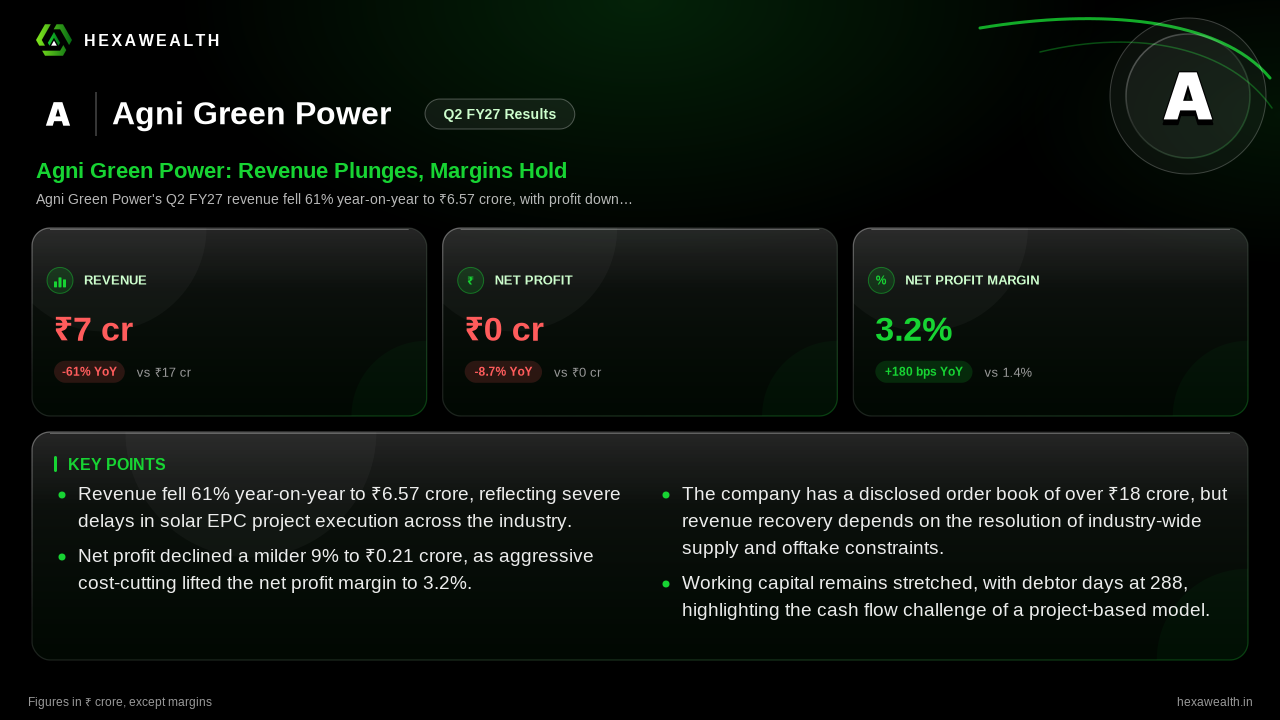
Agni Green Power's Q2 FY27 revenue fell 61% year-on-year to ₹6.57 crore, with profit down 9%. The drop reflects sector-wide delays in project awards and execution, though disciplined cost management lifted the net profit margin.
For solar EPC contractors, revenue is a function of projects moving from award to execution. Agni Green Power’s September quarter shows what happens when that flow stops, with revenue collapsing by over 60% from a year ago. Yet, a sharp pullback in costs kept the company in the black, offering a lesson in margin discipline during a drought.
The numbers tell a story of contraction. Revenue fell to ₹6.57 crore, down 61% from last year and 70% from the previous quarter. Net profit of ₹0.21 crore was 9% lower year-on-year. The only positive was a net profit margin of 3.2%, which actually improved from 1.4% a year ago.
Revenue & profit
Revenue (₹ Cr)
Profit (₹ Cr)
- Revenue (₹ Cr), Q4 FY25: 24.93
- Revenue (₹ Cr), Q2 FY26: 17.0
- Revenue (₹ Cr), Q4 FY26: 21.6
- Revenue (₹ Cr), Q2 FY27: 6.57
- Profit (₹ Cr), Q4 FY25: 0.47
- Profit (₹ Cr), Q2 FY26: 0.23
- Profit (₹ Cr), Q4 FY26: 0.61
- Profit (₹ Cr), Q2 FY27: 0.21
Revenue (₹ Cr)
- Revenue (₹ Cr), Q4 FY25: 24.93
- Revenue (₹ Cr), Q2 FY26: 17.0
- Revenue (₹ Cr), Q4 FY26: 21.6
- Revenue (₹ Cr), Q2 FY27: 6.57
Profit (₹ Cr)
- Profit (₹ Cr), Q4 FY25: 0.47
- Profit (₹ Cr), Q2 FY26: 0.23
- Profit (₹ Cr), Q4 FY26: 0.61
- Profit (₹ Cr), Q2 FY27: 0.21
Net Profit Margin
- Net Profit Margin, Q4 FY25: 1.9%
- Net Profit Margin, Q2 FY26: 1.4%
- Net Profit Margin, Q4 FY26: 2.8%
- Net Profit Margin, Q2 FY27: 3.2%
| Metric | CurrentQ2 FY27 | Same quarter LYQ2 FY26 |
|---|---|---|
| Period | Sep 2026 | Sep 2025 |
| Revenue (₹ Cr) | 6.57YoY -61% | 17.0 |
| Profit (₹ Cr) | 0.21YoY -8.7% | 0.23 |
| Net Profit Margin | 3.2%YoY +129% | 1.4% |
Why the top line vanished
The revenue plunge was not unique to Agni Green. Reports from Saur Energy India and QuarterMark describe an industry-wide bottleneck. New utility-scale awards slowed as developers grappled with the ALMM-II mandate for domestic solar cells, scarce and costly compliant modules, and delayed power purchase agreements.
These structural delays meant expected notices to proceed for new projects did not arrive. For a project-based business, that translates directly into a quarter with little to build. The company’s total expenses fell in lockstep with revenue, down 62% year-on-year.
The cost control that saved the quarter
With revenue evaporating, the bottom line was defended by slashing costs. Employee costs fell 8%, and interest expense dropped 21% sequentially. The result was that profitability on each rupee of sales actually improved.
Live Chart
· AGNI
(BSE)
ISIN: INE0LF301013
The net profit margin expanded by 180 basis points from a year ago. A zero tax expense, as reported in the filings, also provided a tailwind to the final profit number this quarter.
The backlog and the wait
The near-term outlook hinges on converting a disclosed order book into revenue. According to a report by ScanX Trade, Agni Green’s total disclosed order book stood at ₹18.16 crore from recent wins in Tripura and Mizoram. Execution on these orders is critical to reviving the top line.
However, the broader industry commentary suggests the logjam may persist for another quarter or two until cell capacity expands and PPA signings accelerate. The company’s working capital, with debtor days of 288 as per Inve.money, will be tested if execution ramps up slowly.
Key Points
- Revenue fell 61% year-on-year to ₹6.57 crore, reflecting severe delays in solar EPC project execution across the industry.
- Net profit declined a milder 9% to ₹0.21 crore, as aggressive cost-cutting lifted the net profit margin to 3.2%.
- The company has a disclosed order book of over ₹18 crore, but revenue recovery depends on the resolution of industry-wide supply and offtake constraints.
- Working capital remains stretched, with debtor days at 288, highlighting the cash flow challenge of a project-based model.
Hexa Perspective
This quarter lays bare the operational leverage and client concentration risks of a small-scale EPC player. The margin defense is commendable, but it is a holding action. The investment case now turns on execution velocity for the disclosed order book and whether industry headwinds ease before working capital tightens further.
The stock’s valuation at a P/E of 34.3, a discount to the industry, already prices in uncertainty. For the narrative to change, investors need to see the ₹18 crore order book convert into reported revenue, proving the slump was a timing issue, not a structural decline.
Also read
Want this applied to your portfolio?
Talk to a HexaWealth advisor, or sync your mutual fund data for insights tailored to your holdings.