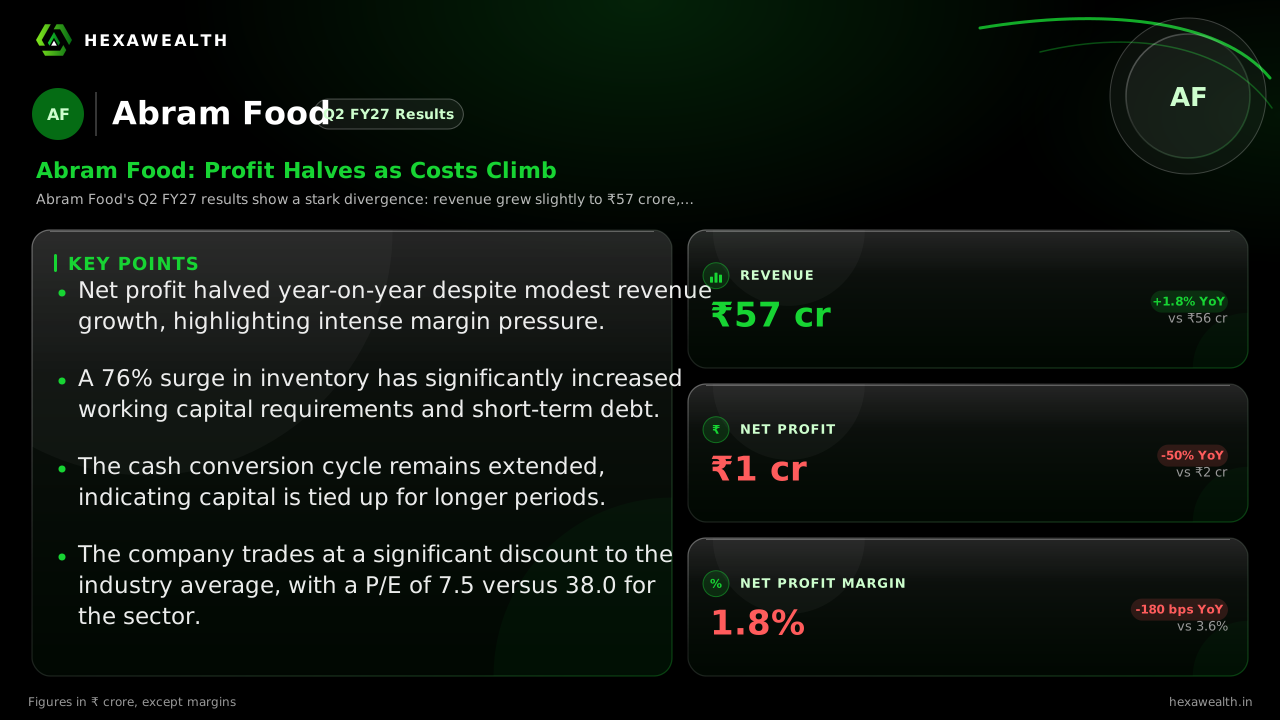
Abram Food (ABRFL)'s Revenue Doubles but Profit Margin Collapses in Q4 FY26
The agricultural trader's sales surged 155% year-on-year, but a severe margin squeeze left net profit flat and halved sequentially.
Abram Food's Q4 FY26 revenue soared to ₹56 crore, yet net profit remained at just ₹1 crore. The dramatic top-line growth, driven by higher trading volumes, was entirely offset by a 270-basis-point collapse in net profit margin.
For a commodity trader like Abram Food, growth hinges on moving higher volumes at stable margins. The March quarter delivered the volume surge but saw profitability evaporate, turning a headline revenue win into a story of margin collapse.
The numbers lay it bare. Revenue hit ₹56 crore, more than double the ₹22 crore from a year ago. Yet, net profit stayed flat at ₹1 crore. Sequentially, with revenue unchanged from September, profit halved. The net profit margin fell to 1.8%, down 270 basis points year-on-year.
Revenue & profit
Revenue (₹ Cr)
Profit (₹ Cr)
- Revenue (₹ Cr), Q2 FY25: 42.0
- Revenue (₹ Cr), Q4 FY25: 22.0
- Revenue (₹ Cr), Q2 FY26: 56.0
- Revenue (₹ Cr), Q4 FY26: 56.0
- Profit (₹ Cr), Q2 FY25: 2.0
- Profit (₹ Cr), Q4 FY25: 1.0
- Profit (₹ Cr), Q2 FY26: 2.0
- Profit (₹ Cr), Q4 FY26: 1.0
Revenue (₹ Cr)
- Revenue (₹ Cr), Q2 FY25: 42.0
- Revenue (₹ Cr), Q4 FY25: 22.0
- Revenue (₹ Cr), Q2 FY26: 56.0
- Revenue (₹ Cr), Q4 FY26: 56.0
Profit (₹ Cr)
- Profit (₹ Cr), Q2 FY25: 2.0
- Profit (₹ Cr), Q4 FY25: 1.0
- Profit (₹ Cr), Q2 FY26: 2.0
- Profit (₹ Cr), Q4 FY26: 1.0
| Metric | CurrentQ4 FY26 | Same quarter LYQ4 FY25 |
|---|---|---|
| Revenue (₹ Cr) | 56.0YoY +155% | 22.0 |
| Profit (₹ Cr) | 1.0YoY 0% | 1.0 |
| Net Margin (%) | 1.8YoY -60% | 4.5 |
Why the top line never reached the bottom
The revenue jump, as reported by ScanX.trade, was driven by higher trading volumes and an expanded portfolio in edible oils and food grains. This volume-led growth, however, came at a steep cost. Total expenses surged 175% year-on-year, far outpacing sales growth.
This divergence points to a sharp rise in the cost of materials. For a thin-margin trading business, even a small mismatch between purchase and selling prices can erase profits. The company's operating profit for the full year FY26 fell 18%, according to the annual analysis.
The cash flow conundrum beneath the growth
Rapid sales expansion has strained working capital. Data from ALFA Finder and lax.sh shows operating cash flow was deeply negative at approximately ₹-16 crore for the quarter. This suggests money is tied up in inventory and receivables as the company scales, a typical but risky phase for a high-growth trader.
Live Chart
· ABRFL
(BSE)
ISIN: INE0ZDY01011
With no specific margin guidance for FY27 mentioned in the research, the path to recovery is unclear. The broader agricultural trade environment, supported by platforms like e-NAM, offers growth avenues. Yet, Abram Food must first prove it can translate that top-line potential into sustainable profits.
Key Points
- Revenue growth of 155% YoY was entirely volume-led but accompanied by a severe 270-bps margin contraction.
- Net profit remained stagnant at ₹1 crore YoY and halved sequentially due to costs rising faster than sales.
- Negative operating cash flow highlights significant working capital absorption amid rapid business scaling.
- The company trades at a significant discount to the industry, with a P/E of 8.8 versus an industry average of 38.0.
Hexa Perspective
The quarter reveals Abram Food in a classic scale-up trap. It has successfully amplified its trading engine, but the mechanism for profit generation has broken down. The valuation discount reflects the market's skepticism that this is a temporary squeeze.
For the story to change, the company needs to demonstrate pricing power or cost discipline in its procurement. Until then, the impressive revenue line is more a measure of activity than of economic value creation. Investors are left watching for a margin inflection that the latest numbers did not provide.
Also read
Want this applied to your portfolio?
Talk to a HexaWealth advisor, or sync your mutual fund data for insights tailored to your holdings.